

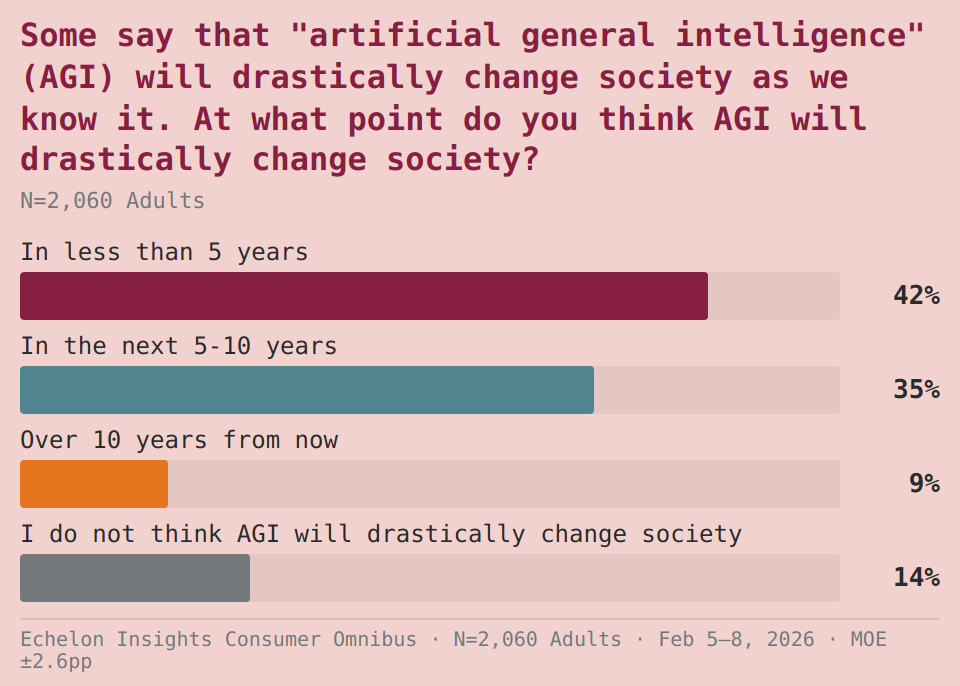
Three in four Americans expect artificial general intelligence (AGI) will “drastically change society as we know it” over the next ten years, according to new polling from Echelon Insights, a data analytics firm.
Echelon’s February consumer and verified voter omnibus surveys also show Americans are concerned about perceived local costs — namely those attributed to data centers — while voters and consumers are roughly split on the wider social benefits of AI.
In the consumer survey, 56 percent of respondents have a very or somewhat favorable impression of AI overall.
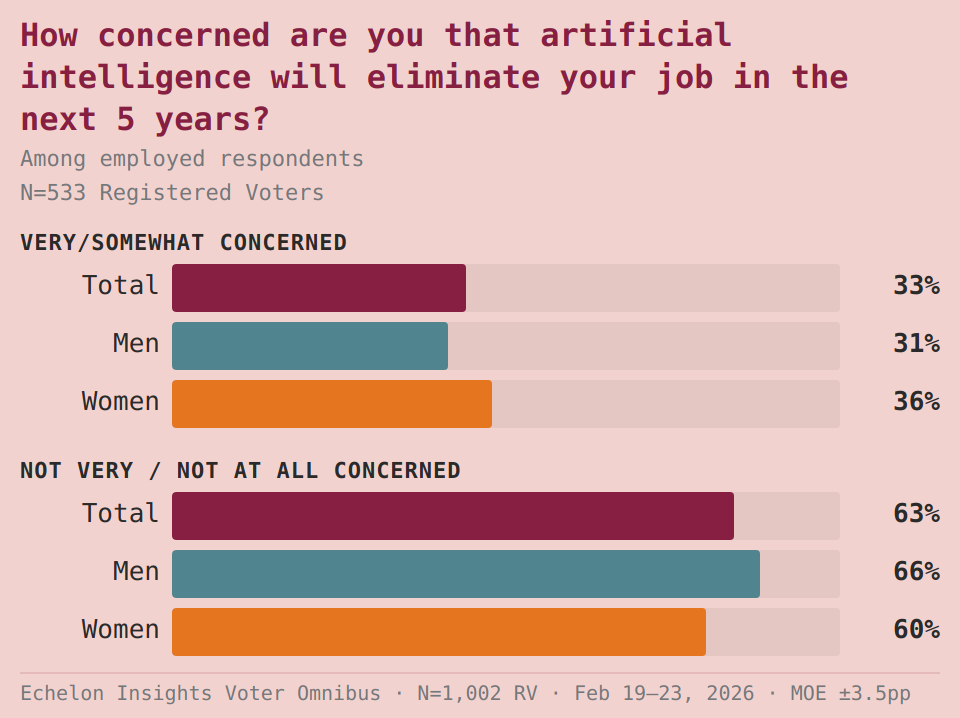
Surprisingly, a full 63 percent of employed respondents to the voter survey are not very or not at all concerned that AI will eliminate their job sometime in the next five years. This stands in marked contrast to some technologists, especially those from frontier labs like Anthropic and OpenAI, who often say they expect mass AI-driven job loss in the years ahead.
To be clear, the end state for long-run employment and automation is shrouded in deep uncertainty and is a contentious debate among technologists and economists, with the latter being more skeptical at the margin.
This voter attitude likely reflects a kind of rational ignorance. Most voters are not coders immediately threatened by new Claude tools, and most are likely responding to proximate indicators of job security. Claude cannot yet fully automate most forms of work.
But the question is when the levee will break. New data from the Bureau of Labor Statistics may already show a boost from AI-driven productivity, according to economist Alex Imas. Firms are beginning to invoke AI as a reason for layoffs, but it’s unclear how much of this is rhetorical strategy versus concrete reality.
The discrepancy between elite worries and mass nonchalance may come as a surprise to analysts in DC and San Francisco, many of whom are preparing for the possibility of mass AI-driven job loss in the short and long run.
DC’s second-place AI city status, however, comes with a more dour vibe. Whereas San Francisco is a city of private utopianism, DC remains a more gloomy exemplar of public pragmatism. As Jasmine Sun writes in her essay about a recent visit to Washington:
DC is arguably the most AGI-pilled city after SF—I’m always surprised to remember that the first chip controls passed before ChatGPT—but the default valences are opposite. Where AI researchers imagine growing a loving machine God, policymakers rush to contain His wrath. Every conversation here starts with damage control.
And calls from voters for more “damage control” will only grow as AI walks without rhythm into the jagged frontier.
That’s already starting to happen. Alongside America’s conflicting mix of optimism and pessimism about AI comes a bipartisan preference for government regulation. Six in ten registered likely voters believe government won’t go far enough in regulating AI while only one in four are worried it will go too far.
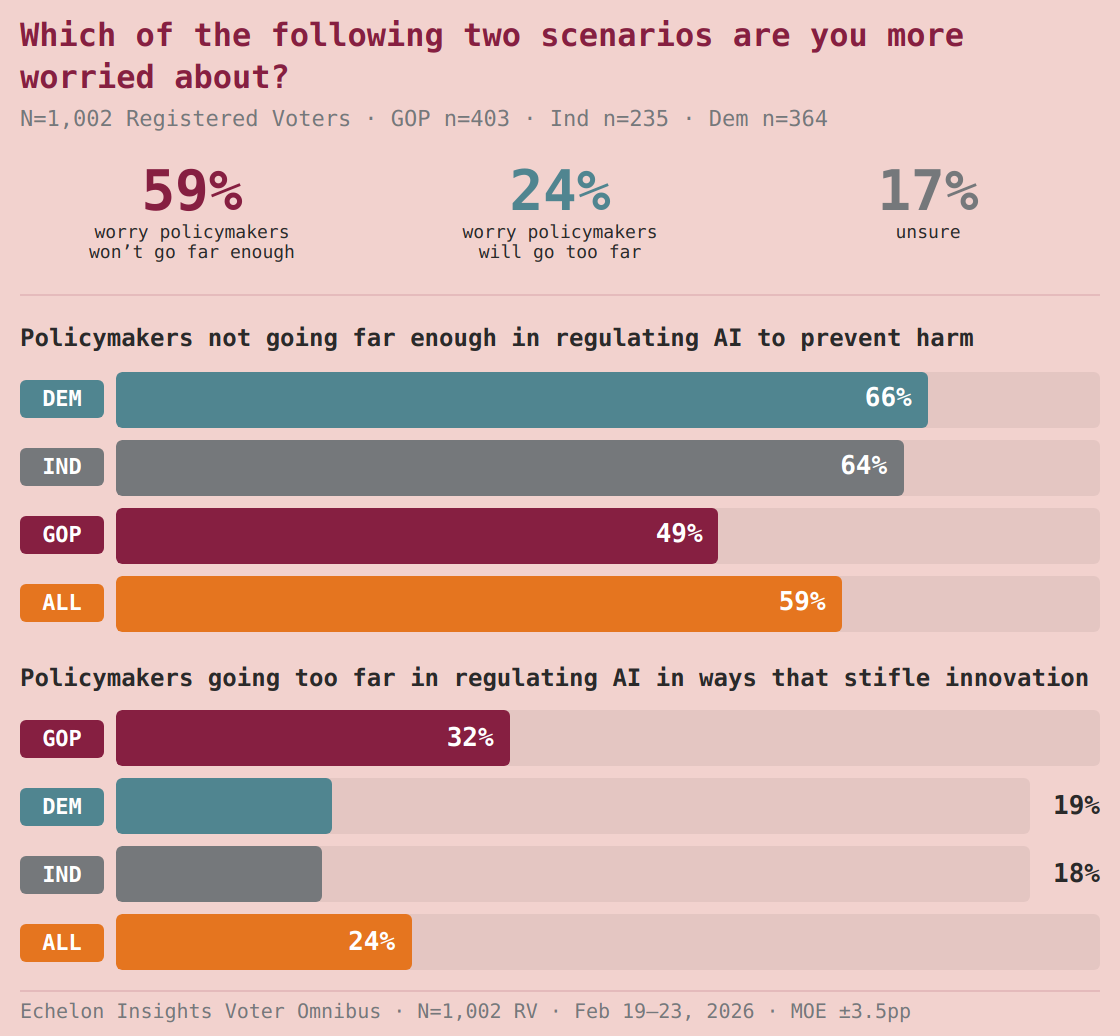
Overall, national views favoring regulation appear to be more firmly settled than views on the technology itself. This reflects a strong precautionary stance, one at odds with the permissionless innovation that is arguably needed for Americans to experiment with deploying AI in ways that work on their behalf.
These mixed numbers also suggest a rapidly closing window for the current administration to pass minimal congressional legislation or a state-law moratorium on AI.
Forecasters on Metaculus, a prediction platform, say the odds of a Republican Senate and Democratic House in 2027 are 66 percent, with Democratic control of both chambers coming in at 21 percent. The odds the GOP will hold both chambers, however, are just 13 percent.
With the odds starkly cutting against a GOP-controlled Congress, the Trump admin will be forced to rely solely on measures within the executive branch, which can be overturned when the White House eventually flips along the partisan axis.
Data centers and electricity costs are quickly becoming the most politically tangible manifestation of national concerns about AI.
In President Trump’s 2026 State of the Union address, data centers and electricity costs were one of only two direct mentions of AI, the other being the First Lady’s Presidential AI Challenge and the TAKE IT DOWN Act, which was signed into law in May 2025 and seeks to combat “revenge porn” and deepfakes.
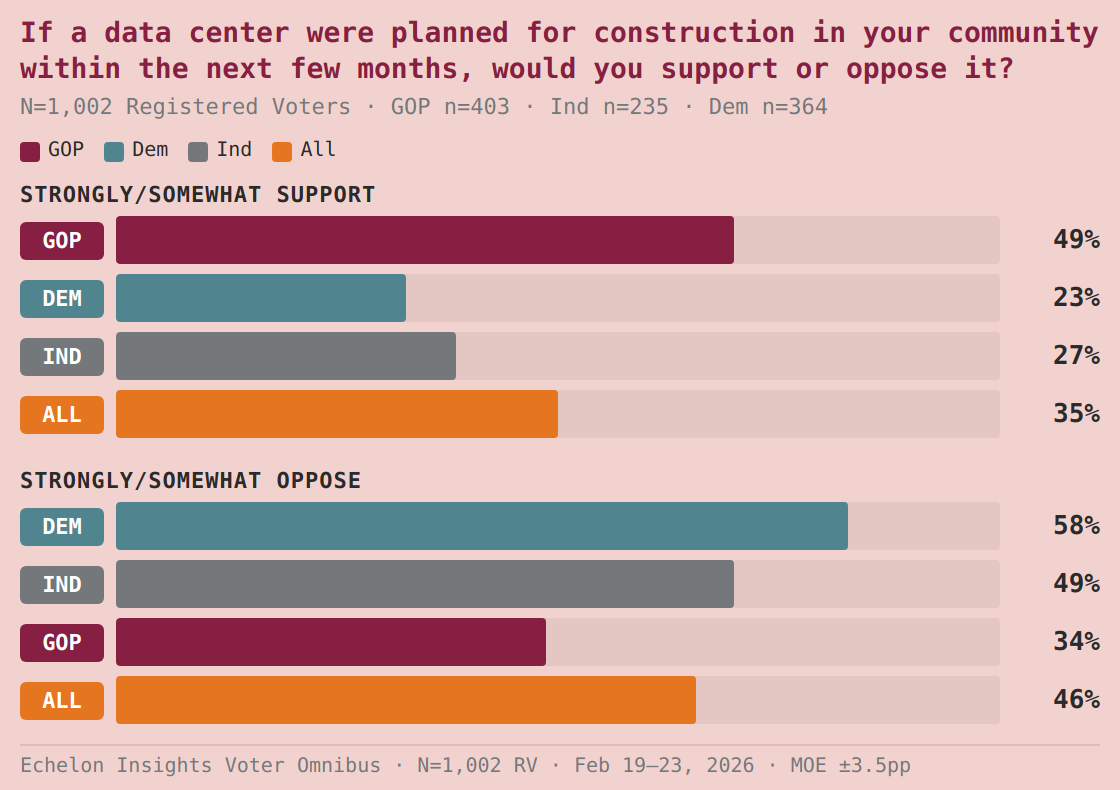
Fears about local data center projects and opposition to their construction align with a pattern observed by the economist Mancur Olson — most famously in The Logic of Collective Action (1965) and The Rise and Decline of Nations (1982).
This is the logic of diffuse costs and concentrated benefits. This dynamic takes many forms, but in this case it may mean that economic growth at the macro level is choked off by organized opposition at the micro level.
In our current context, local voters opposing new AI data centers receive some real or imagined benefits from restricting construction while the broader public bears the costs of less AI-driven innovation.
If there are fewer data centers, however, progress in AI will slow, including downstream advances in medicine, transportation, manufacturing, and many other domains. In this sense, whatever cautious optimism is held by American voters may be undone by their bipartisan instinct to welcome more rather than less regulation of data centers and AI systems.
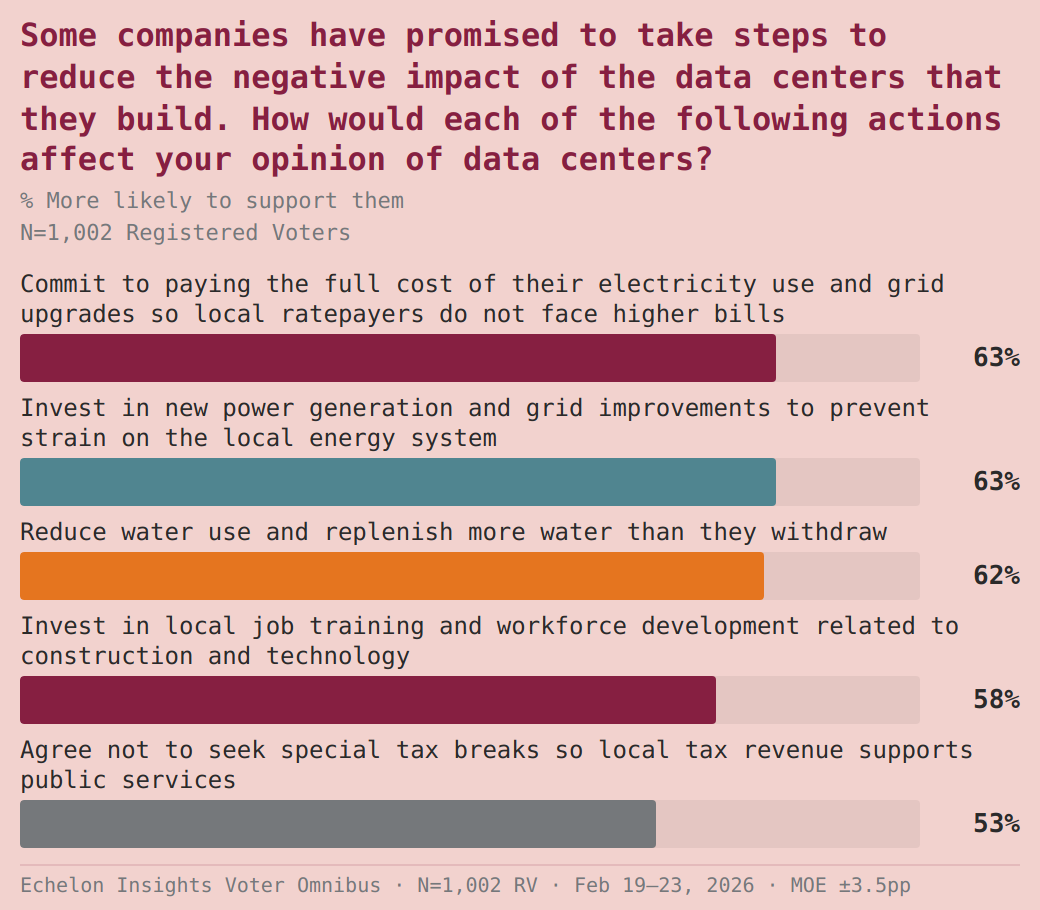
The good news, the survey responses suggest, is that hyperscalers and other data center providers might address voter concerns with fairly high-ROI, good-faith strategies that could help stave off the Olsonian doom loop — at least for now.
Building new grid capacity is one such strategy and is an effective way to curtail electricity costs.
Better communication is also needed from industry and public officials when it comes to claims about the environmental costs of AI, many of which are overstated or outright specious, as Andy Masley has shown repeatedly.
These strategies won’t forestall capricious regulatory actions at the federal level — they certainly won’t affect macroeconomic performance or stop the US from pursuing foreign wars. But they may help firms and voters better adapt to what many analysts expect will be a decade of intense creative destruction.