
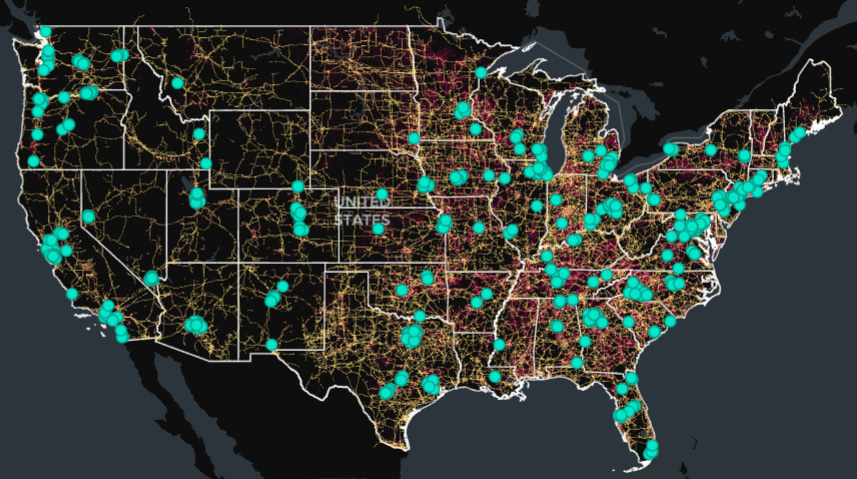
When Winter Storm Fern tore through the US this past week, leaving 548,000 US customers without power south of the Mason-Dixon Line, policymakers and residents alike feared the worst. National periodicals pondered whether the state’s rapid scaling of data centers and energy infrastructure could withstand the environmental pressure, or lack thereof, as Fern would have it.
But the Lone Star grid held up. ERCOT reported no calls for conservation and no outages systemwide.
Five years ago, however, it was a different story altogether. The destructive Winter Storm Uri forced the Texan grid to a frozen halt in mid-February 2021.
The Electric Reliability Council of Texas (ERCOT), which manages around 90 percent of the state’s power load, saw 5.2 million customers lose power, leading to 276 deaths, mostly in Texas.
Federal regulators called it America’s largest ever controlled blackout. It was an especially bitter pill as Texas had faced yet another major storm in 2011 — the Groundhog Day blizzard — yet fell short of full adaptation in the aftermath.
Not long after Winter Storm Uri pummeled Texas in 2021, economists Vernon Smith and Lynne Kiesling suggested several reforms in an op-ed for The Dallas Morning News. They argued that critics of the 2021 ERCOT failure blamed “unreliable” natural gas plants and wind turbines, a lack of grid interconnection, and the alleged failure of ERCOT’s generally market-based model.
But in lamenting this model, critics overlooked the role of local knowledge and the price system. Smith and Kiesling argued that “even traditionally regulated top-down allocation methods require information that is inherently decentralized.” Resilient policymaking would require regulators to work with, not against the price system when preparing for extreme risks.
To that end, Smith and Kiesling argued ERCOT should lean into its market-based model. They outlined a three-prong approach for ERCOT that encouraged the regulator to do the following:
“Implement clear market rules requiring natural gas generators to have firm supply contracts in order to be certified as an eligible resource for emergency conditions.”
“Incentivize more customers to reduce consumption in return for bill savings, creating demand flexibility.”
“[Increase] battery storage, which has been made increasingly economical due to innovation.”
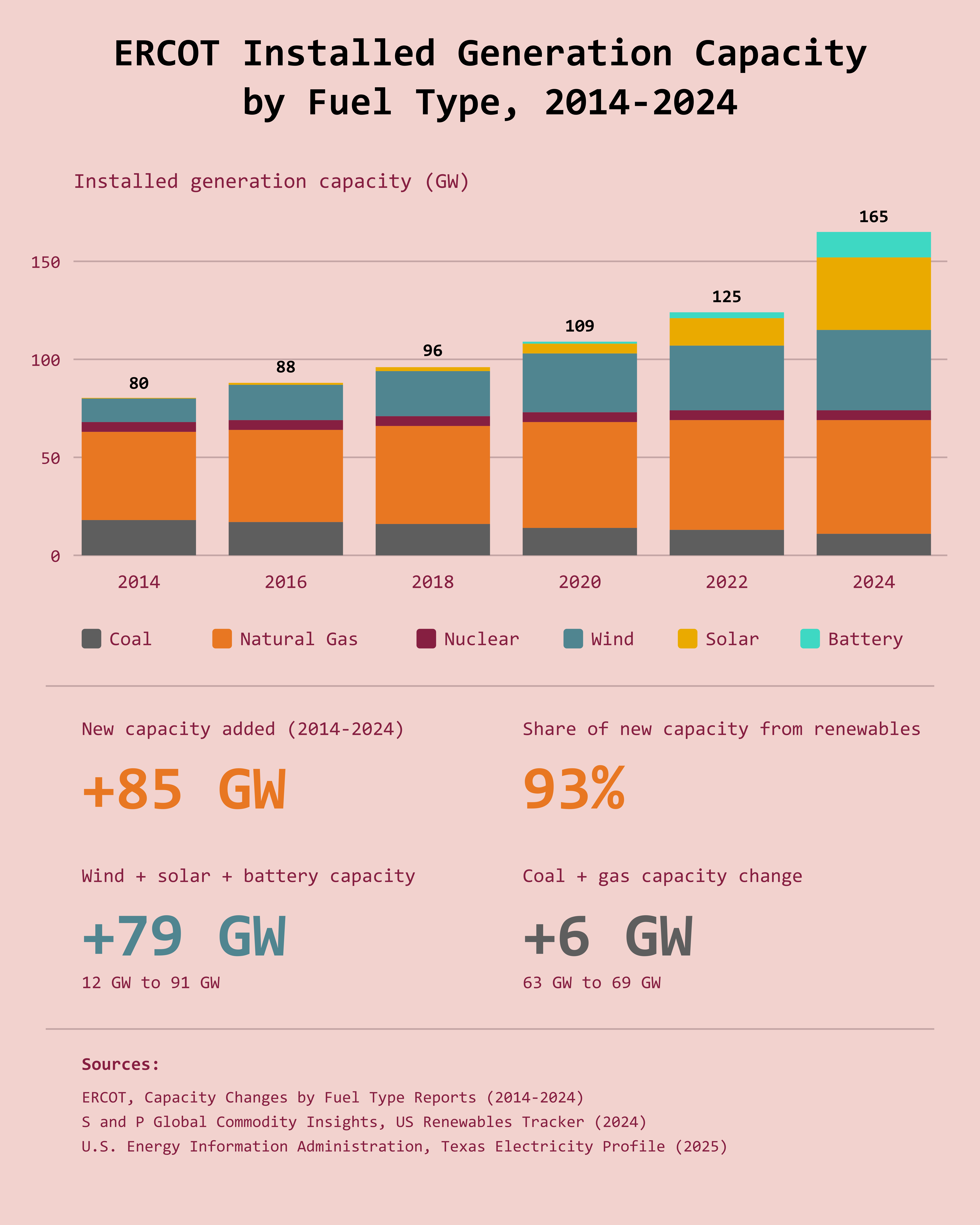
While Texas legislators and regulators made some movement on the first two prongs, the major winner in the long run was the increase in battery capacity for the Texan grid.
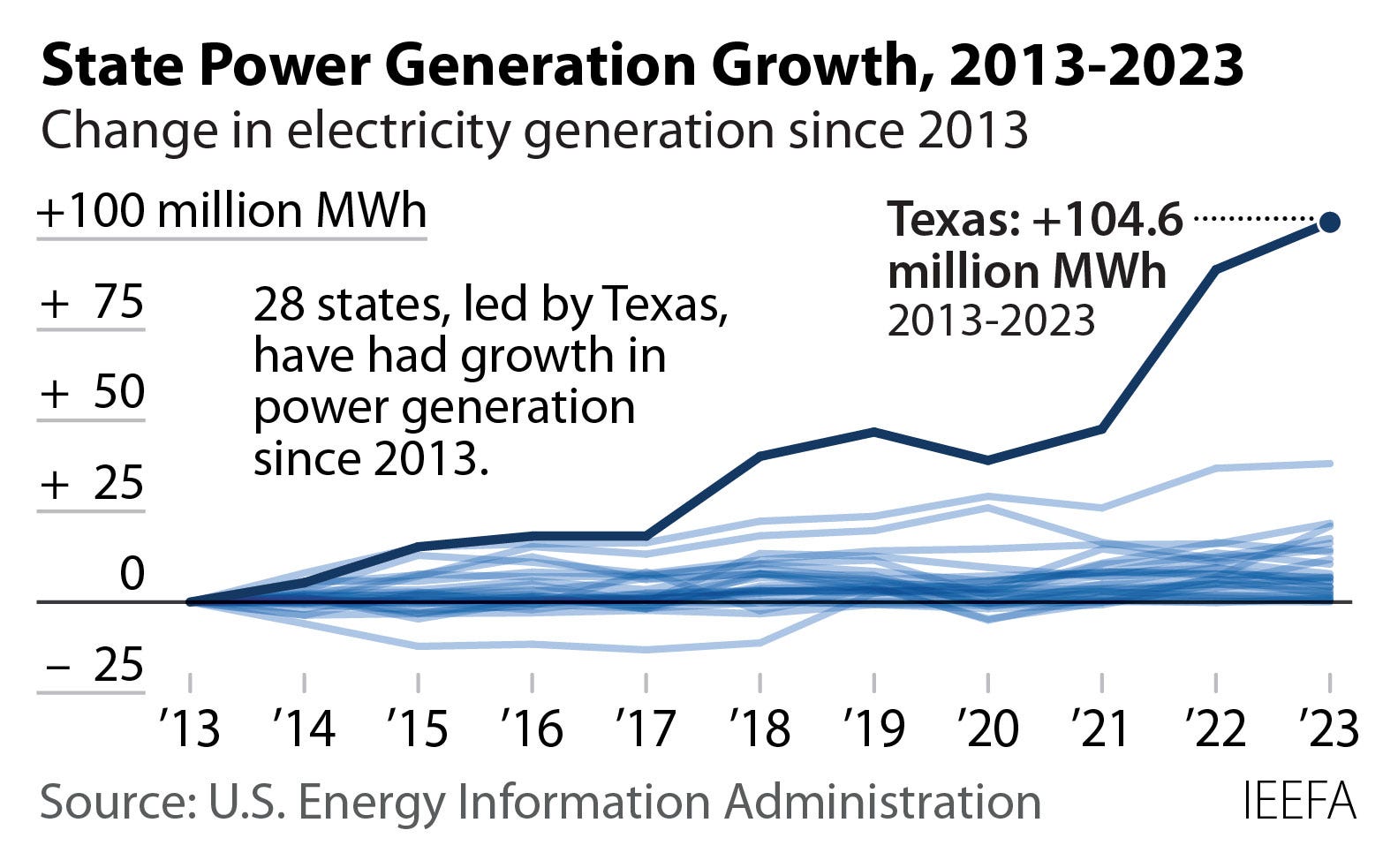
The expansion of Texas’s generation capacity and resilient infrastructure happened alongside the modern AI revolution and heavy demand for new data centers. But thanks to grid expansion efforts that began over a decade before the launch of ChatGPT in 2022, Texas was well-placed to continue building out infrastructure that might otherwise easily bog down more regulation-heavy states like California and Virginia.
Texas’s abundant energy generation capacity and more market-based regulatory approach makes the state of Texas an attractive destination for new data centers and other advanced industrial projects. Today, the city of Abilene hosts the main site for Stargate, the world’s largest AI data center project — a joint project of OpenAI, SoftBank, Oracle, and MGX. Meanwhile, Austin is still home base for Tesla, with HQ known as “Gigafactory Texas.”
Here’s Lynne Kiesling again:
The story of AI and electricity is ultimately a story about how fast innovation collides with the slower rhythms of physical infrastructure. Data centers can scale on an 18-month horizon; the grid that powers them requires years of planning, permitting, and construction.
Given that dynamic, it’s shocking just how much Texas’s new generation capacity comes from renewables. Of the 85GW added to the grid from 2014 to 2024, a full 93% of that capacity came from wind, solar, and batteries. How did this happen in one of the most politically right-of-center states in the Union? Joshua Rhodes, a UT Austin research scientist puts it more bluntly, “Texas didn’t do it for an energy transition reason at all. We just made it easy to build things here. And so people started building things here.”
As a functionally intrastate power grid, ERCOT is mostly (not entirely) outside the jurisdiction of the Federal Energy Regulatory Commission, which regulates interstate energy markets. Though ERCOT does not generally fall under the auspices of FERC, it is still subject to oversight from Congress and the Department of Energy. In 2015, Congress even amended the Federal Power Act (originally signed in 1920) to clarify authorities and “prioritize electric reliability over environmental outcomes, essentially by providing a waiver of federal, state, or local environmental laws and regulations during times of emergencies.”
The New York Times reported on Monday that:
This is the first major test of the power system’s resilience during a potent winter storm in the era of huge data center expansion. In an unusual move, the Department of Energy late Sunday ordered the manager of Texas’ main electric grid, [ERCOT], to direct data centers and other facilities that consume a lot of energy to begin using backup generators in an effort to prevent blackouts.
That was a justifiable decision given the real and projected severity of this week’s storm and the lingering trauma of the 2021 Texas power crisis. But why did the order for Texan data centers to switch to backup come from the Department of Energy rather than directly from ERCOT? In short, because federalism is very weird, and because ERCOT itself requested the DoE order as it would be unable to take some emergency actions without federal approval.
Texas Senate Bill 6, which was signed into law last summer, had already made provisions for this contingency. Data Center Frontier, an industry publication, reports that SB6 requires data centers (and other large energy users) “to fund infrastructure upgrades, enable remote disconnection during emergencies, and register backup generators to bolster grid reliability.”
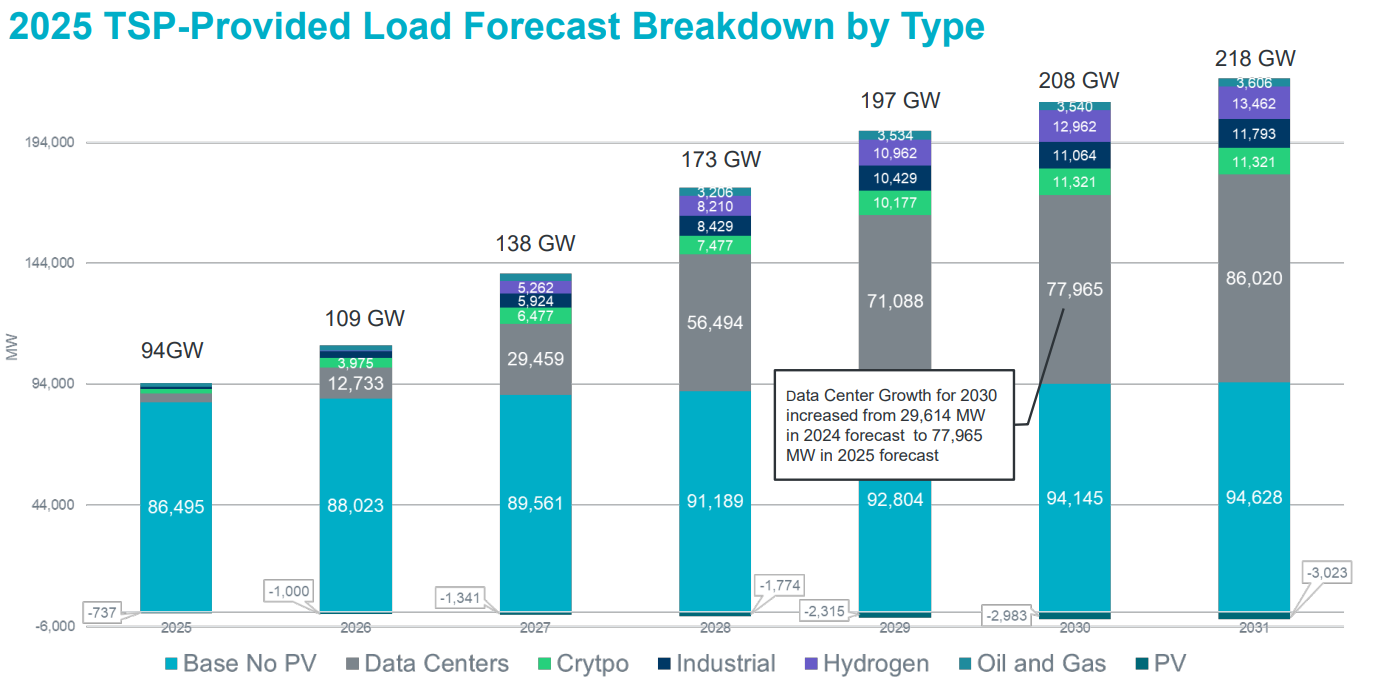
From storms to hyperscalers, everything wants to be bigger in Texas. This is no less true when it comes to market-driven efforts to scale data centers, energy, and resiliency throughout the state over the last decade. All of this comes despite ongoing risks from extreme weather and an uncertain federal regulatory approach to AI, which Congress has kicked to the states until further notice.
Texas leads the nation in the tornado frequency at 133 per year. While a direct hit is the less likely scenario, executives are still (at least mentally) preparing. Here’s HUB Executive Vice President Kirk Chamberlain on the topic:
A tornado could take an entire site down… The problem is the models insurance companies use were never really designed for a $20B data center because you don’t typically see $20B of anything sitting in the way of a tornado in the Midwest.
Maybe it was foolish to summon the “sand god” in the nominative shadow of Tornado Alley? Then again, Silicon Valley already sits atop the San Andreas Fault.
The Spindletop gusher kicked off the Texas oil boom in January 1901. Half a century later, Morris Chang, the founder of TSMC, made his name in the semiconductor industry as an engineer at Texas Instruments before leaving for Taiwan in the early 1980s.
Now the waves of industrial progress are bouncing back to the Lone Star state — not because of tariffs or federal industrial policy. Rather, as Ben Klutsey writes, it’s the resilience “embedded [deep] in the American design… the software of our institutions, our culture, and our decentralized way of solving problems.”
It’s the kind of frontier scrappiness that keeps the lights on and the fire going… if we’ll tend to it.