
2025 was a violent year for American AI governance, and 2026 will continue this trend. American AI policy in the first year of the second Trump admin is best described as having been disruptive and energetic — in good ways and bad. But the sale of advanced chips to China alongside this week’s Anthropic-DoD dust-up suggests the balance is now tilting toward the bad kind of disruption.
We should expect this tension to continue — policy progress favoring AI development at the agency and office levels alongside sporadic regress at the cabinet and presidential levels. The balance of the two will determine the President’s AI legacy, though the more disruptive elements are unlikely to derail the long-run trajectory of American AI. Thankfully, that technological pathway is more dependent on long-standing institutional factors, like the US innovation ecosystem, capital markets, and our greater constitutional-legal order. Still, executive misfires add up, create a chilling effect, and cost the US valuable time just as Chinese AI models trail American models by a matter of months.
When it comes to the AI Action Plan and the Genesis Mission, the administration’s energetic disruption has been a welcome one — a conscious callback to the vision and vibe of Vannevar Bush. The White House’s Office of Science and Technology Policy and the National Institute of Standards and Technology have shown good sense in navigating the risks and opportunities of AI while reawakening a sense of American optimism and private-public collaboration. Many other lesser-known offices and agencies are doing the thankless work of preparing for a world transformed by powerful AI systems. This government-wide posture is a marked change from the more risk-focused admin that preceded it. It is also a departure from the mutual distrust that defined Silicon Valley and Washington, DC for a generation.
But when it comes to DOGE, tariffs, high-skilled immigration, selling advanced chips to China, and now the President’s directive to label Anthropic a “supply chain risk” — we’re tilting toward the bad kind of disruption. The executive branch’s attack on Anthropic is a form of elite in-fighting in which the assailants are willing to burn down the village — never their own domicile — in order to make a point. Normally that point is just the advancement or retrenchment of authority and status. This week’s events are no exception.
This governance strategy starts at the top. The admin’s aggregate behavior cannot be explained merely by the baroque theories held by various staffers. That is, you will not find any one worldview that maps the territory — be it neo-mercantilism, post-liberalism, unified executive theory, anti-communism, neoconservatism, defensive realism, or the New Monroe Doctrine. These are all important lenses for understanding the preferences of many principals and their deputies, but these theories often conflict with each other, and contests between them are typically only resolved by the President and his innermost circle, if they are resolved at all. Truman got it right — the buck stops at the Resolute Desk — by design and happenstance alike. This is a natural result of the great strain we have placed on the Presidency, along with the human tendency to form hierarchies when status is zero-sum.
The President has been clear about his personal aims and ambitions from the start. This has been true across his two terms, from his First Inaugural Address decrying “American Carnage” to his Second Inaugural Address, which bore no mention of artificial intelligence, semiconductors, robotics, or much else that defines great power competition in the technological realm. Consistently, rather, the President has stressed the need for tariffs, immigration enforcement, and territorial expansion. This is where he has focused his efforts. And he has succeeded in doing so by direct executive action, not by strong congressional law-making.
Arguably, no major legislation has been accomplished in the second Trump admin beyond the One Big Beautiful Bill Act and (for AI at least) the TAKE IT DOWN Act, signed into law on July 4th and May 19th of last year, respectively. The admin’s signature policies — “Liberation Day” tariffs, ICE deportations, and military actions against Venezuela and Iran — were all executive rather than legislative in nature. All have been sudden and violent. They are visceral decisions in line with the major objectives the President has proclaimed since as far back as the 1980s.
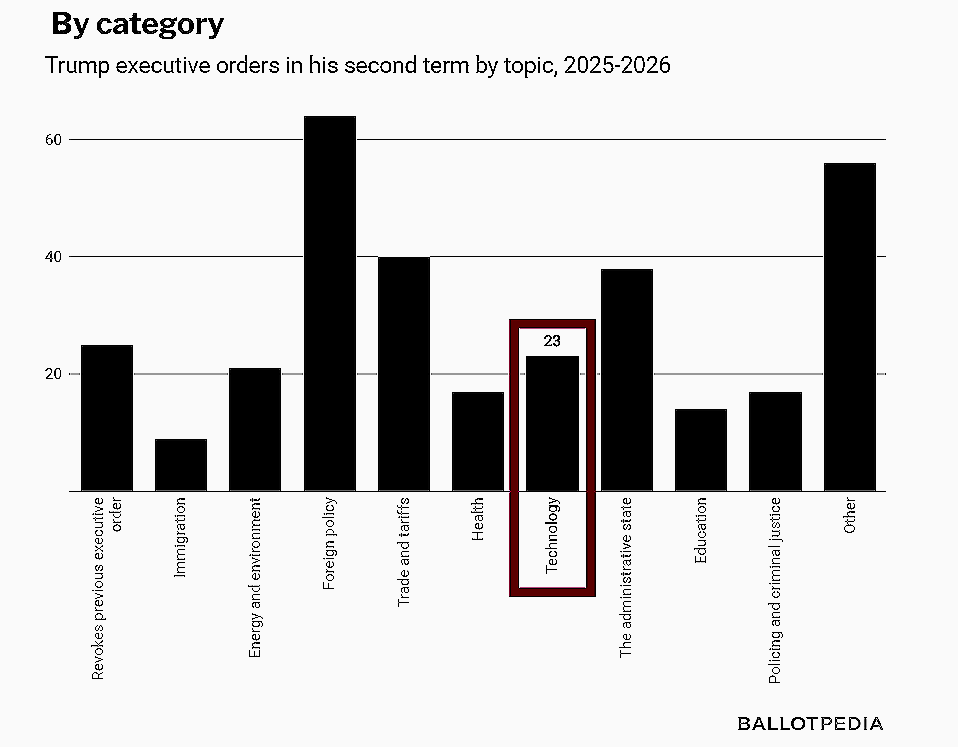
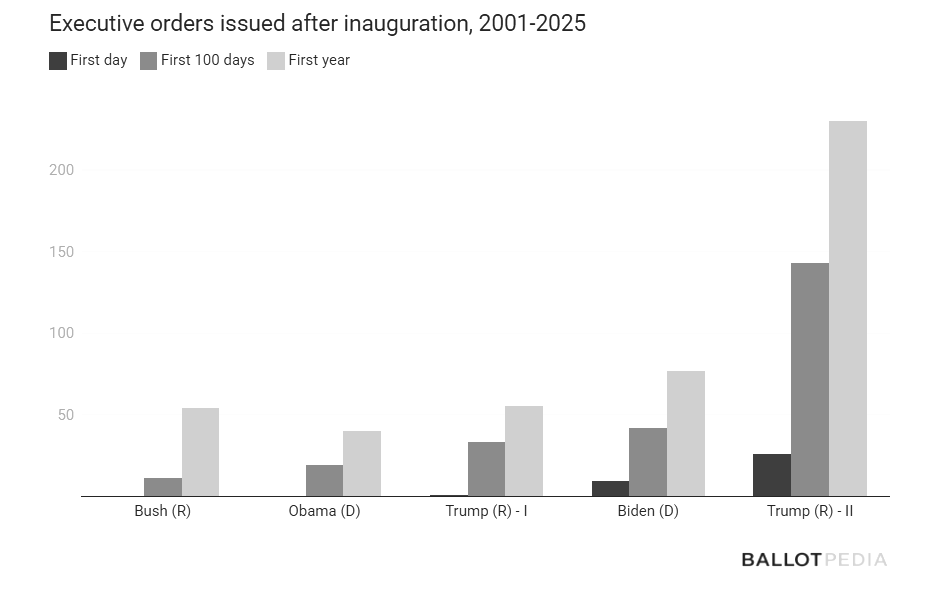
So far, the major leaps in AI policy have been accomplished by way of Executive Order, which are presidential instructions to the bureaucracy rather than full-fledged laws. Moreover, AI-related Executive Orders made up between 3 and 10 percent of the 2025 EO pie, depending on whether one takes a broad or narrow classification strategy. This is considerable but still roughly half the amount of EOs devoted to trade and tariffs and about a third of the EOs dedicated to foreign policy. All of these can be and likely will be rescinded by the next Democratic administration. Indeed, this ritual cleansing of past EOs is something the current administration did on its first day in office. If you live by the EO, you may die by the EO. Many things are being written but very little is being built — at least in terms of robust legislation, like the 2022 CHIPS and Science Act.
Take the most recent AI-focused Executive Order, last December’s “Ensuring a National Policy Framework for Artificial Intelligence.” It includes deadlines for five of its six prongs. Noticeably, it sets no deadline for what should be its most important measure, a “legislative recommendation establishing a uniform Federal policy framework for AI that preempts State AI laws that conflict with the policy.” (NB: The White House URL uses the title of the leaked EO draft from November, “Eliminating State Law Obstruction of National Artificial Intelligence Policy,” which can plausibly be read as “Eliminating SLOP,” which is clever.) Congress now has less than a year before it will likely rebalance following the midterm elections. Because of that timeline and the lack of urgency in pushing for a minimal, unified legislative framework, the Trump administration is missing a critical window to secure American AI dominance. Meanwhile, states like California, New York, and Florida are in the process of passing major, uncoordinated legislation on AI. MultiState.ai reports that states have already enacted 145 AI-related bills in 2025, though not all of these are major pieces of standalone AI legislation.


The failure to secure lasting congressional AI legislation or a workable moratorium is partly the result of the personalization of American institutions. The political theorist Francis Fukuyama writes that “Trump’s enduring legacy is not an institutional structure, but rather a highly toxic culture that has been adopted by many of the president’s followers and will live on after he is gone.” The President has so far not ushered in anything like the New Deal or the Great Society. But vibe shifts do count for something. Sometimes, they last longer and do more than legislation or major Supreme Court rulings. The pre-constitutional two-term norm for the presidency lasted one and a half centuries before it was shattered by President Franklin Delano Roosevelt, who died just months after his Fourth Inaugural Address. I’m not certain the President has violated liberal-democratic norms to that degree, but the point is that some of the deepest changes are those made in the text of our unwritten constitution. The illegible often dominates the legible.
Secretary of Defense Pete Hegseth’s aggressive, needless actions against Anthropic this past week bear out this whole dynamic. The “warrior culture” he has brought into the DoD is not one that is primarily concerned with liberal fairness but rather with the imitation of pre-liberal or aristocratic honor, the kind that places ego over efficiency. In many ways, it’s a DOGE re-run. Questions about executive control of the administrative state are legitimate, whether for civilians or warfighters. But instead of resolving conflicts with reasonable adjudication that reconciles American enterprise and civilian control of the military, we get what Jasmine Sun calls “state capitalism with American characteristics.” This has been the administration’s impulse across the board, from rare earth minerals to semiconductors. The point is to assert dominance and expand the boundaries of power. The equilibrium is that every national policy debate gets conscripted into the culture wars.
The act of Hegsethian revenge is not a one-off. That behavior gets you respect in the Oval Office. The point is to make an over-the-top display of regulatory violence in response to a perceived insult such that future contenders are soundly deterred. It is a signal wrapped in absurdity and delivered with force. It certainly got the President’s attention — likely an overdue response to Anthropic CEO Dario Amodei’s refusal to court presidential approval on other matters, like advanced chip sales to China, which Anthropic opposes. Whatever the story, these new norms of re-personalized politics are not building a resilient future — not when Chinese state-sponsored spies can deploy Claude Code while DoD staffers are told to stand down.
A technological republic, if we can keep it.