
.jpg)
Machine Culture just hit 200 subscriptions! Thanks to everyone who got the word out. I’m hoping to reach 300 by the first anniversary of the pub’s launch this May. To help get there, would you consider passing Machine Culture along to a friend or colleague? 🦾
I. My Week with the AI Populists
The indefatigable Jasmine Sun recently visited Washington, DC [welcome!], observing that many AI natives in DC and San Francisco are radically underestimating the rise of voter backlash.
An excerpt:
DC is arguably the most AGI-pilled city after SF — I’m always surprised to remember that the first chip controls passed before ChatGPT — but the default valences are opposite. Where AI researchers imagine growing a loving machine God, policymakers rush to contain His wrath. Every conversation here starts with damage control.
Her reporting is always well-written and info-dense — lots of good “worm’s-eye view” commentary on the SF-DC nexus.
II. Dark Fiber
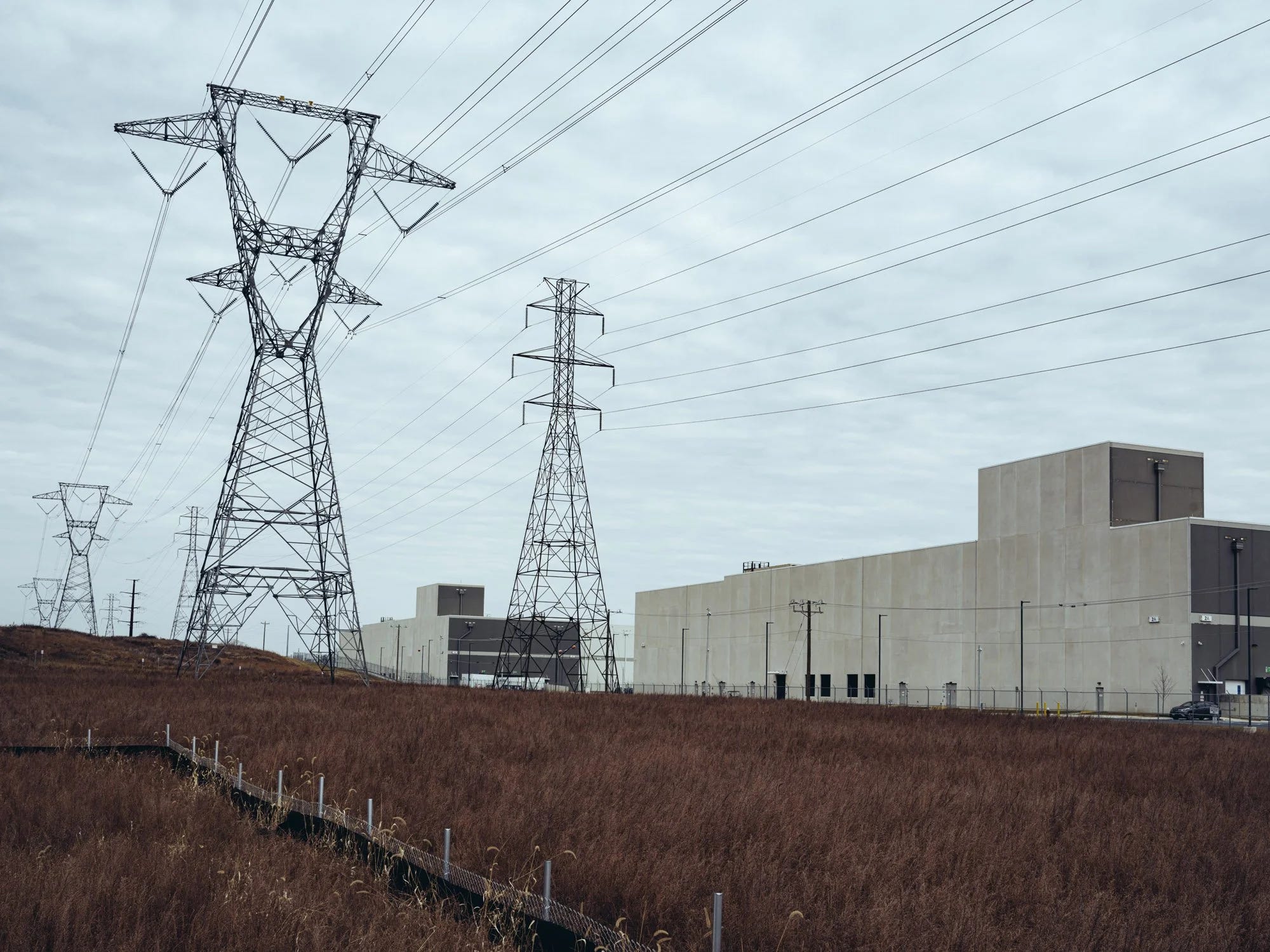
In the aforementioned article, photojournalist Stephen Voss appears as a local guide to NoVa’s sprawling data center metropolis. It’s a brilliant collection of work, evoking a kind of photographic expression of Precissionism, the highly geometric modernist art movement that emerged in America after World War I.
III. Underdetermination at the Frontier
Elsie Jang shows, once again, why AI research needs the philosophy of science. This time the target is recursive self-improvement (RSI), “a process in which an intelligent system improves its own capabilities, and those improved capabilities in turn allow it to make further improvements to itself, which enable still further improvements, and so on.”
[If RSI seems hard to grasp, then please watch this vaguely unsettling 1976 Czech animation about the evolution of crab robots. It may not clarify anything, but you can at least send it to your friends and they will be just as gobsmacked and/or believe you are a fine connoisseur of Eastern Bloc avant-garde animation.]
The ongoing uncertainty about the future of RSI is a good example of what philosophers of science refer to as “underdetermination of theory by evidence.” Unlike more benign historical examples of underdetermination, Jang notes that “the evidence which definitively settles the question [of RSI] may arrive only after the window for policy preparation has closed.” So… stay frosty.
IV. The Perma-Twilight of Our Youth
Will AI extend human adolescence? I offer some assorted thoughts:
[A]s groups grow and integrate into larger social networks, individuals can finally breathe and think about the long run. Younger individuals are required less and less to become immediate contributors to social welfare. They move from being a net cost to a net benefit. But the paradoxical result is that we end up in a world that feels like adulthood is always pushed further back.
Researchers in cultural evolution — the interdisciplinary study of gene-culture co-evolution — will have their hands full for a while.
If you read one person on the AI Summit 2026 in New Delhi, read Shruti Rajagopalan — there is literally no better guide to the political economy of India.
Her TLDR/BLUF?
“India’s AI regulation (surprisingly light-touch and sensible)”
“Foundational models (promising but narrow)”
“Semiconductor ambitions (literally and metaphorically built on soft soil)”
“Energy constraints (a real political economy bottleneck)”
“Startup ecosystem (world class talent)”
“Blossoming venture funding (burdened by tax uncertainty)”
But do read the whole thing…