

The midterm flood has redrawn the electoral map, sweeping in Democratic control of the US Senate, House, and more than half of state governorships. Voters across the country rejected the “tech-trad alliance,” once the coalitional foundation of the second Trump administration.
Voters did not reject the populism beneath that partnership. They simply redirected its flow sharply up and toward the left. Pro-AI super PACs did not fare well last night. Nor did Elon Musk’s vast political spending, which turned up short. Candidates who opposed data centers did especially well. Georgia’s Democratic senatorial candidate Jon Ossoff even gave a shout-out to the existential risk of AI in his victory speech. “P(doom)” is now a term one might hear on the campaign trail.
Less than two years ago, Jeff Bezos, Mark Zuckerberg, Sundar Pichai, Tim Cook, Elon Musk, Sergey Brin, and Sam Altman sat near the President in the Capitol Rotunda —— a techno-industrial show of force to herald a new era of dynamism.
But American voters never got on board, and they have made one thing clear —— the techlash will continue until morale improves. And it is not improving.
Yet despite this popular revolt, the midterm wave is unlikely to radically alter America’s frontier AI policy over the next two years. Paradoxically, the biggest winner of the 2026 US midterms may be the administrative state and the bureaucrats who run it. Elected officials and political appointees may come and go, but Washington’s core infrastructure will remain in place —— the gray technocracy unstained by the biennial red and blue tides.
Congress was hardly involved in frontier AI policy in any substantial way before the midterms. Now, in a divided government, Congress will be less involved in the positive creation of frontier policy, though it will retain its negative powers to jawbone and cajole, check and balance as needed. The next Congress will likely be a raucous departure from America’s emerging system of frontier AI governance, which has not heavily relied on Congress up to this point. It is unlikely to be a departure oriented toward actionable policymaking. Until now, Republican legislators have seen fit to take their cues from the executive branch, which has preferred “muddling through” frontier policy rather than providing comprehensive leadership. A Democratic Congress is not about to change that.
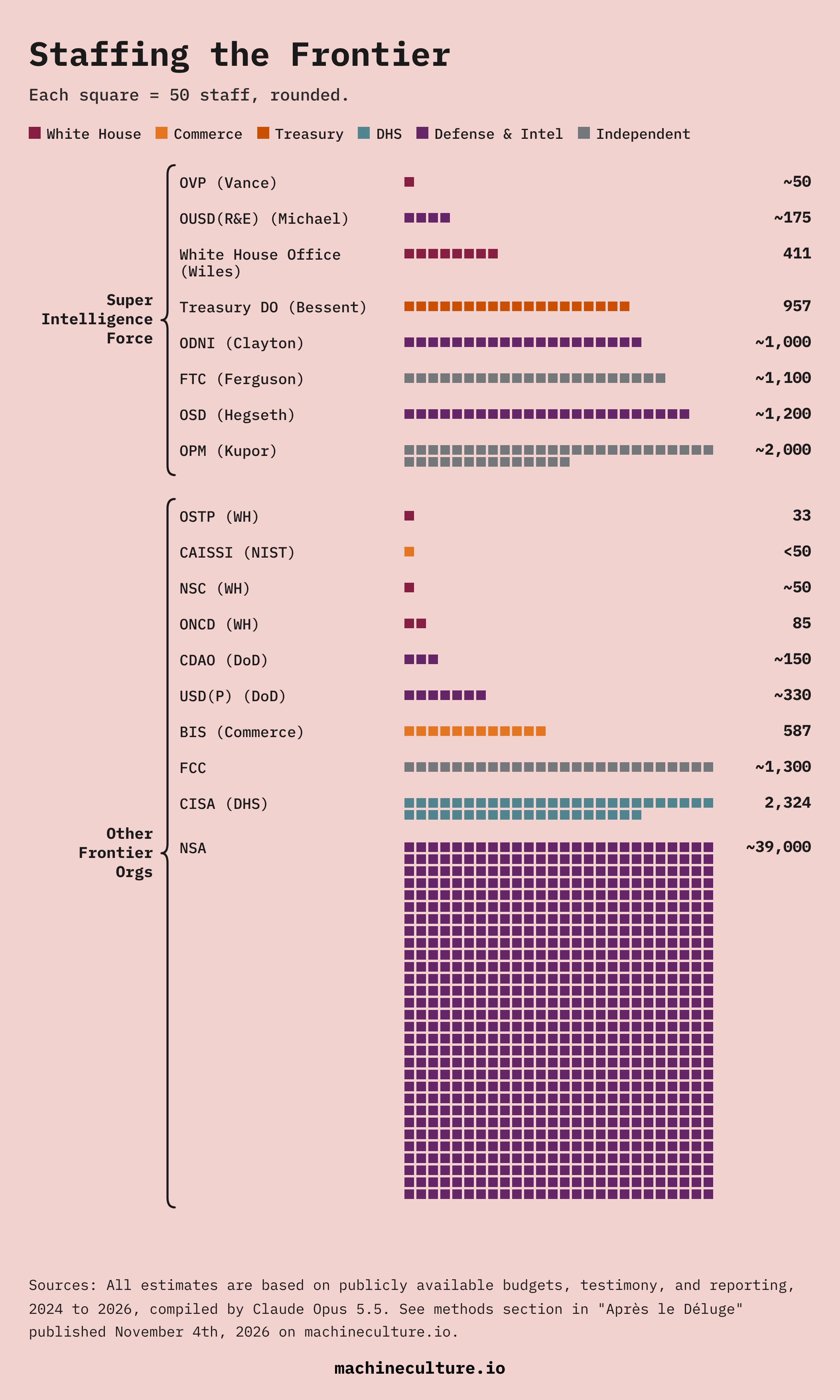
So who exactly is at the helm?
Frontier AI governance in DC is managed by four overlapping groups: accelerationists, safetyists, populists, and bureaucrats. They all agree the US must lead in frontier AI, but differ (crucially) on what that actually means.
Accelerationists, who tend to hail from industry and finance, believe the American tech stack must be allowed and even helped to grow rapidly so that the US —— or at least US firms —— can dominate globally. Nvidia CEO Jensen Huang is the most notable representative of this group.
Safetyists, on the other hand, are more inclined to believe AI must be well-regulated —— “pacing the frontier” —— to avoid catastrophic risks, like those stemming from runaway recursive self-improvement or loss of control scenarios. Anthropic CEO Dario Amodei is preeminent among this crowd.
Populists, for their part, believe AI must first serve and never undermine or disparage American families and workers. Vice President JD Vance, a self-proclaimed hillbilly elegist and protégé of Peter Thiel, is the standard-bearer here, though he has embodied the uneasy tension of the alliance. Florida Governor Ron DeSantis is a clearer example. He has leaned into a more socially conservative populism, one not entangled with Silicon Valley.
Bureaucrats, finally, are the most practical of the bunch. Their first goal is to ensure that AI supports and strengthens US state capacity. They may believe other things about frontier AI, but they tend to be less “AGI-pilled” than their pure accelerationist or safetyist counterparts. That is, they often do not have an apocalyptic or millenarian view of the transformative power of AI, though some certainly may, especially those who share a deeper kinship with their industry counterparts.
These civil servants constitute the permanent government of Washington, the embodiment of state capacity with all the risks and opportunities that entails. They are the ones who quietly shape frontier AI policy on export controls, model evaluations, autonomous weapons, cybersecurity, and critical infrastructure. And it is the bureaucrats who stay behind when the accelerationists, safetyists, and populists leave after their electoral tours. (Yes, some do stay.) It is the bureaucrats who make their homes between the Potomac and Anacostia rivers.
Yet their stationary loyalty has its tradeoffs. Above all else, the administrative state is most adept at self-preservation. It cultivates and defends a kind of institutional conservatism. And it withstands quixotic attempts to restrain it, as it did most recently when Elon Musk’s Department of Government Efficiency (DOGE) tore through it.
The only reforms the administrative state can stomach in the long run are those reforms that cause the state to grow amid cataclysmic circumstances —— the New Deal, the Great Society, or the Global War on Terror. The political economist Robert Higgs called this dynamic the “ratchet effect,” the process whereby state growth clicks forward but rarely backward past a certain point. Perhaps the new era of transformative AI will be one of these forward-clicking points. That is unlikely to happen in a divided government, when the addition of mutually agreeable laws becomes much trickier for both parties.
Still, the new Democratic coalition of legislators will not be timid or boring. We should expect Democratic lawmakers to bring many hearings, impeachments, subpoenas, and even the occasional shutdown. Each event will serve a number of purposes: besieging the administration, signaling to voters, and hosting intraparty fights between progressives and centrists. Governing frontier AI laboratories is unlikely to be among these purposes. That turf has been claimed by the bureaucrats.
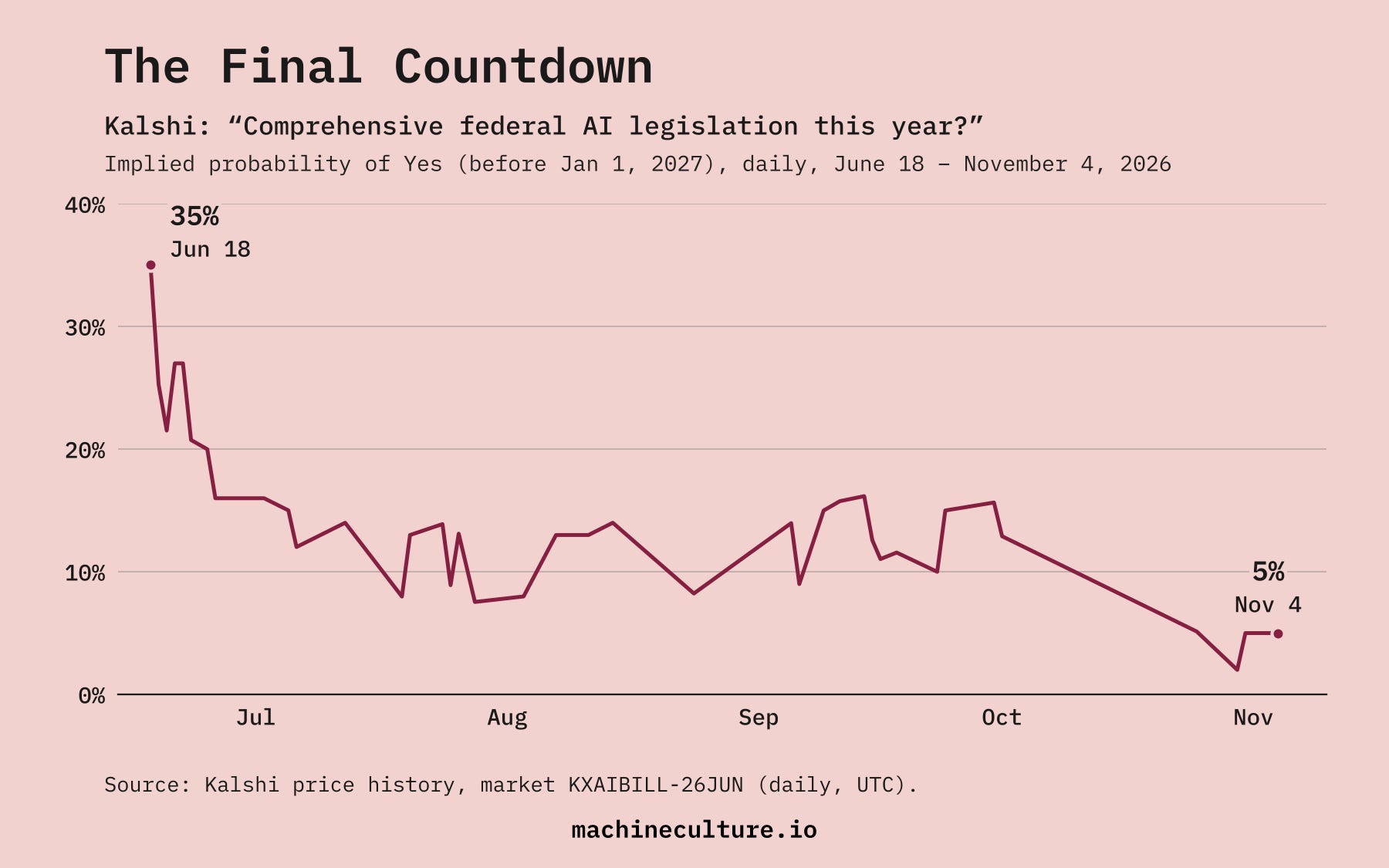
But until the new legislators begin their work next January, do not expect the current, Republican-led Congress to rush toward a comprehensive AI law. The market has already priced in low odds for that, according to the prediction market platform Kalshi. And do not expect the next batch of legislators to right the perceived wrongs of the present administration. Time is not on their side.
What could break the coming two-year gridlock? It may be the President —— a wild card even unto himself. “We’re going to work with the Democrats to make sure things go well for our country,” President Trump told Politico last night, when the Republican Party’s electoral fate became undeniable. “I don’t want to sit here for two years just vetoing everything.” The option is his, a prerogative given to the head of America’s administrative state.