


The imbroglio over Anthropic’s Mythos 5 and Fable 5 model launch shows “muddling through” is alive and well in American democracy. It is an uncertain, disappointing bargaining process for all involved —— frontier labs, policymakers, and AI safety advocates alike. But the never-ending negotiation between states and markets beats the top-down planning offered by democratic decelerationists and authoritarian accelerationists. We are better off with the mess.
How did we get here? Consider the timeline, a chaotic “will they, won’t they” policy drama that unfolded across the spring and summer in conversations from San Francisco to Washington to Évian-les-Bains, where the most recent G7 meeting was held.
Anthropic launched Fable 5 and Mythos 5 on June 9th. Three days later, the Department of Commerce’s Bureau of Industry and Security gave the company a mere ninety minutes to disable both models and comply with new export controls. Talks with Commerce stalled through the middle of the month before turning to a narrower fight over vulnerability disclosure. Commerce lifted the directive on June 30th, and Fable 5 returned worldwide the next day behind a new safety classifier, with Mythos 5 still gated to vetted American organizations.
Policymakers and the voters who sent them are waking up to the smell of transformative AI at home and abroad. Everyone is ill at ease and can find something to praise or scorn in the Rube Goldberg machine that is American frontier AI governance.



Yet, despite the chaos, the market trundles on, seemingly unbothered by the disorder at the top. At the very least, financial markets are preoccupied with other matters —— the AI capex boom, sticky inflation, interest rates, federal debt, and simmering geopolitical conflict. In light of these macro factors, a few bad months of near-term uncertainty are manageable given the promise of epoch-defining IPOs arriving this year or next. Anthropic recently told investors its revenue increased fourteen-fold year-over-year in the second quarter of 2026. That is ahead of an IPO that is on track to be the largest ever if the frontier lab floats at $2 trillion or more this October. If Anthropic has suffered financially as a result of the vagaries of the administration, it sure has a strange way of showing it.
It’s all so much “muddling through,” to invoke an idiom that likely entered the English lexicon in the 19th century. That phrase characterizes a kind of governance Charles Lindblom described in his classic article, “The Science of ‘Muddling Through.’” In that 1959 article, Lindblom compared two kinds of governance, the “rational-comprehensive” or “root” method versus the “successive limited comparisons” or “branch” method. They are two modes of problem solving, the former common to theorists and the latter common to practitioners. Silicon Valley insiders might call the root method “big design up front” and the branch method “move fast and break things.” Or, they might call the two methods “the cathedral and the bazaar,” as the software developer and essayist Eric Raymond put it in his book and essay of the same name.
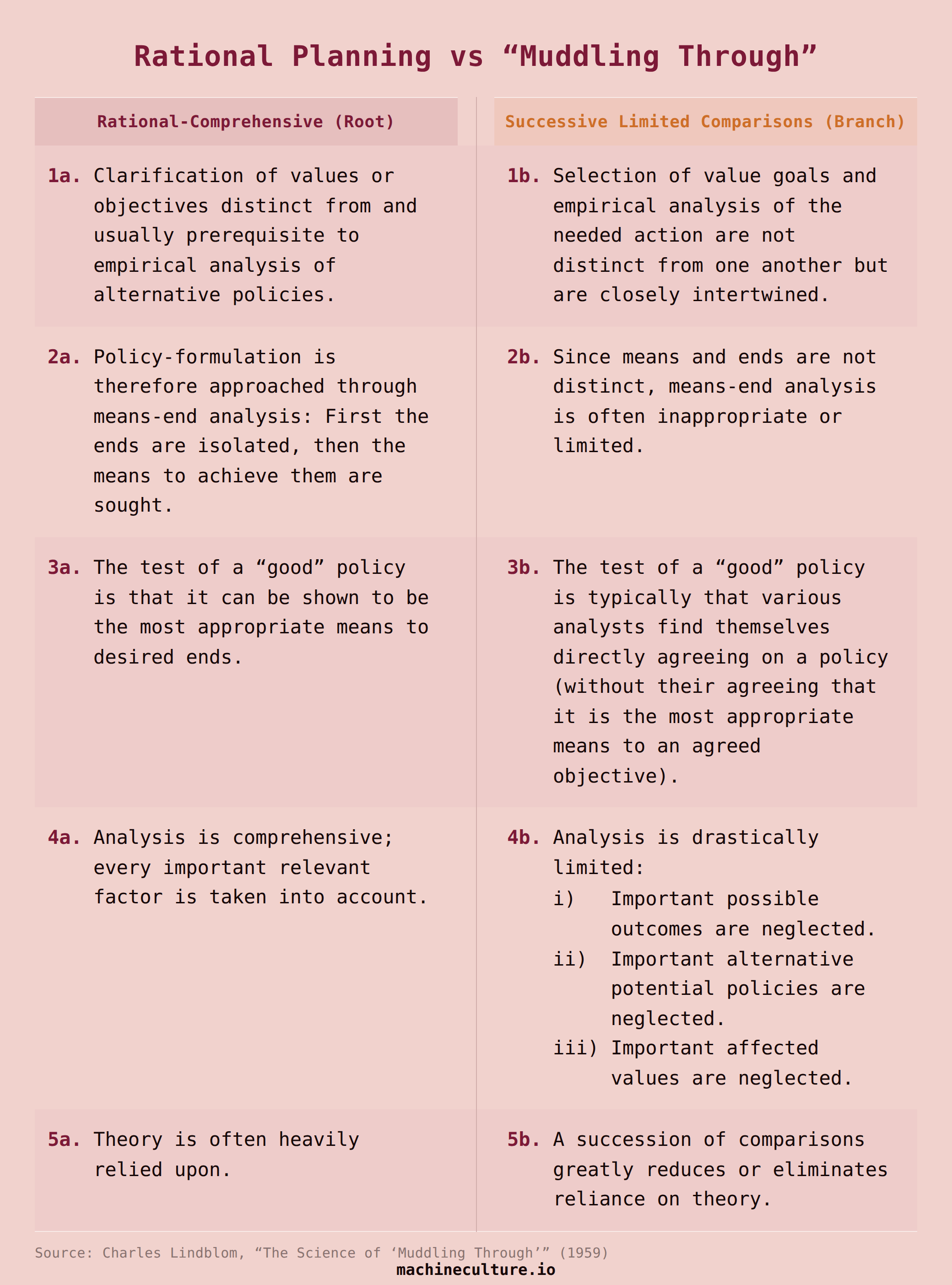
Lindblom explained the central thesis of his work:
[S]ome of the most superficially wasteful, ugly, disorganized, and chaotic aspects of politics have something of the character of unplanned, unintended epiphenomenal coordination roughly comparable to that […] accomplished by market organization.
Lindblom, a student of Frank Knight’s at the University of Chicago, dedicated his scholarly life to the study of this manner of problem-solving, a theoretical defense of gradualism or incrementalism. An economist by training and a political scientist in practice, he defended practical administration and democratic pluralism at a time when centralized, scientific administration promised more enlightened policymaking. His work, however, was not a carte blanche defense of all policy improvisations. Rather, it was an explanation of what he saw as the four basic elements of political-economic organization: markets, hierarchy, bargaining, and polyarchy or “real world imperfect democracy.” It was a defense of the political bazaar against the policy cathedral.
For the rational planner, it is tempting to approach the recent Mythos controversy with the lament that we have not yet secured a well-calibrated, long-term framework for frontier AI governance. Such a framework, many argue, must be established now in order to ward off various plausible catastrophic scenarios —— the kind that need only happen once before it is too late. The urgency of the situation —— the long-foreseen shock of models like Mythos —— nudges the technocratic mind to plan, plan, plan. Every question about frontier governance must be settled now in a rational-comprehensive program that gets to the root of the problem. And starting at the root, it must consider each and every branch, sufficiently addressing every relevant, pressing question —— federalism, liability, great power competition, state capacity, chemical, biological, radiological, and nuclear (CBRN) risks, autonomous weapons, superalignment, child safety, consumer welfare, mass unemployment, hyperabundant windfalls, and existential hope. Take a number.
Francis Fukuyama recently made the case for the rational-comprehensive method of policymaking in response to the Trump administration’s “chaotic” AI policymaking. He writes:
It is time to stop talking about whether we need an AI regulator; the dangers are here and now and we need to move quickly. The discussion needs to shift to a much deeper and more specific analysis of how to regulate, understanding that the dangers posed by AI are likely to change over time. Our main competitor, China, is moving in this direction as we speak: the country is not run by a bunch of libertarians who want to let the technology rip, come what may. That may have been our position in the past, but it can’t define our policy today.
Fukuyama has been an astute critic of the President and would likely agree that the chaos starts at the top. While presidents hardly direct much of what happens under their watch, they do set the ethos of each administration. That buck starts as well as stops at the Resolute desk. So, given the chaos of today’s presidential leadership, how much confidence should we have in the administration’s readiness to regulate AI rationally and comprehensively by way of a “specialized regulator” for AI? The best work in any administration tends to be carried out in the most professionalized, least televised domains, after all. Tacit knowledge beats grandstanding when it comes to sound policymaking, and rational-comprehensive planning tends to draw grandstanders.
Most striking in Fukuyama’s call for more rational AI policy is the comparison with China. He is correct that China is not run by libertarians. Nor is the White House, for that matter. If White House officials share any unifying worldview, it is a kind of mercantilism, as Anton Leicht has aptly described it. Even so, it remains unclear why a democratic polity should look to a one-party state for guidance on much of anything. The ends and means of authoritarian states are almost entirely alien to those enjoyed by a healthy democracy. But the rational-comprehensive mind occasionally envies the power and authority held by the likes of the Chinese Communist Party. That envy is misplaced.
For all the successes of economic growth, technological diffusion, and accelerationism with Chinese characteristics, there remains a dark shadow to Chinese technocracy. The examples are myriad: the Great Leap Forward, the Banqiao dam collapse and death-toll secrecy, the brutal enforcement of the one-child policy, the suppression of COVID-19 reporting and the austere zero-COVID lockdowns, recurring anti-involution campaigns to limit industrial excess, and the disappearance of Jack Ma followed by the sudden cancellation of Ant Group’s 2020 IPO. While rational-comprehensive planners are not necessarily authoritarian, to do their job adequately —— to engage in comprehensive institutional design and execution —— they need a high degree of surveillance and control.
These two modes of problem-solving —— the root and branch methods —— characterize the emerging conflict between the US and China. As writer Dan Wang argues in his book, Breakneck: China’s Quest to Engineer the Future, “China is an engineering state, which can’t stop itself from building, facing off against America’s lawyerly society, which blocks everything it can.” Wang’s explanatory dichotomy is apt. It’s also another way of saying that strong property rights and polyarchy are core to the American common law system. At its worst, muddling through without limits becomes “kludgeocracy.” Rational planning without limits, however, becomes authoritarian. If the failure modes of these two systems are puzzling at first glance, they become clearer when we ask the planner whose justice and which rationality he may be invoking.

The assumption of a theory-laden “view from nowhere,” however, is commonplace in discussions about frontier AI governance. Take, for example, the recent “Pacing the Frontier” letter signed by employees of the leading frontier AI labs. Their request is deceptively simple:
We request that the US government support an international effort to develop the technical and governance tools needed to deliberately pace the frontier of automated AI development.
But latent in each seemingly anodyne phrase is a sweeping array of assumptions about the possibilities of superintelligence and diplomatic cooperation between US and China. These assumptions are baroque and contested, even within the small world of AI governance researchers. If one were to replace the phrase “frontier of automated AI development” with “economic growth,” the request would sound more like something written by Greta Thunberg or the Club of Rome. Ultimately, the proposal has the benefit of committing its signatories to little while signaling that one is appropriately “AGI-pilled” and aware of the inescapable geopolitical dimensions of managing AI risks.
So, how might the US pursue the request made in that letter? One example is Plan A, outlined in AI 2040, a group of narrative scenarios —— published before the “Pacing the Frontier” letter —— detailing what the emergence of artificial superintelligence might look like globally. Plan A calls for (or at least describes) heavy coordination between the US and China to slow the development of AI and avoid out-of-control recursive self-improvement. The recommendations are sweeping and comprehensive: “humanity delays the development of superintelligence until 2040, makes all AI research public, allows dozens of companies globally to catch up to the frontier, and intentionally enters a regime of mutually assured compute destruction.”
The establishment of this global regulatory regime, however, would require unprecedented levels of surveillance and control, trading away real civil and economic liberties to ward off plausible, albeit theoretical, catastrophic risks. The point is to slow, surveil, and control the development of AI so that rational planners can then have enough time to continue to slow, surveil, and control the development of AI. While Plan A is perhaps more democratic than the Chinese Communist Party, it does not adequately hedge against the historically grounded risks of centralized political control, which it obliquely recommends.
That mode of life is almost certainly preferable to extinction by a rogue superintelligence, but it also accepts a false dichotomy that says such risks cannot be mitigated without sweeping controls. This was exactly the argument made by some anti-nuclear advocates during the Cold War, who believed nuclear energy could only be managed by a strong, centralized power. “If you accept nuclear power plants, you also accept a techno-scientific-industrial-military elite. Without these people in charge, you could not have nuclear power,” writes one critic quoted by Langdon Winner in his essay, “Do Artifacts Have Politics?” By rejecting that centralized power, one would then be required to reject civilian nuclear power as well. None of this, however, has made the world safe from nuclear weapons. It has only curtailed the diffusion of nuclear power domestically, leading to worse ecological outcomes at home and abroad.
Better approaches are needed, then, to mitigate catastrophic risks without centralizing power, and the only way out is through, with better, faster muddling. The branch method is especially well-suited to making progress on intractable problems amid deep moral disagreement. Its strange, sometimes chaotic unfolding is what happens when policymakers make incremental gains while respectfully navigating around the rights and duties of the open society. The branch method is not allergic to scientific analysis, which is useful when the problems are novel and constrained. Rather, the root and branch methods are mainly about the scope and sequence of decision-making, not whether they are open to empirical investigation.
Think tanks like the Institute for Progress (IFP) exemplify this strategy, finding small, leveraged policy interventions that lead to big gains —— a kind of policy arbitrage amid partisan gridlock. One can see this clearly in the IFP’s recent policy brief, “How Should the US Prepare for Increasingly Automated AI R&D?” That paper offers “23 low-regret policy recommendations” that Lindblom himself might have stamped with muddling approval.
To help policymakers begin addressing the risks of further automating AI R&D, we propose opting for near-term policies that: (1) focus on serious and irreversible harms, (2) minimize slowdown in the diffusion of existing AI capabilities, (3) have upside even if automated AI R&D and its attendant risks prove unlikely, (4) avoid systematically disadvantaging more cautious companies and countries, and (5) avoid establishing a regulatory apparatus that is likely to be misused.
I suspect most writers and signatories of AI 2040 and “Pacing the Frontier” would assent to the measures drawn up by IFP. And that is a testament to the power of muddling through, the ability to navigate and even circumvent disagreement with marginal improvements to safety that take seriously the risks of recursive self-improvement and superintelligence.
For now, we find ourselves staring at the roots while living among the branches of frontier AI governance. We are forced to make decisions under deep uncertainty about a general-purpose technology that reaches across every facet of our lives. The regulatory object —— a vast web of compute, data, software, and human systems —— is evolving at a rapid clip. AI systems quickly trespass across competing jurisdictions, a swiftly moving target defying the slow, careful study we have come to prize in nearly every policy domain. Because of this, AI is especially subject to the strange, particular, and idiosyncratic habits of polyarchy. Add to that fundamental questions about AI’s desirability and capability, and you get the perfect conditions for muddling through. The process is long and incomplete, and that is good.