


Argument in Brief
AI agents are transforming global commerce, and the US and China are now building standards to guide these agents. Developing voluntary AI agent identity standards—what an agent is and who operates it—is already a core objective for the US Center for Advancing Innovation and Standards for Super Intelligence (CAISSI). But agent jurisdiction—the legal authority whose laws ultimately govern an agent and its operator—has not received comparable attention.
To address this gap and ensure US primacy in global AI agent standards, Congress should consider the following actions:
I. Formally establish CAISSI within the Department of Commerce.
II. Direct CAISSI to convene an agent jurisdiction working group.
III. Direct CAISSI to develop incident-reporting standards that account for agent jurisdiction.
Without a strong US effort to address agent jurisdiction in its geopolitical context, China will have increased leverage over the terms of cross-border agentic commerce. This brief explains the challenges that agent identity and jurisdiction standards pose for cross-border commerce, examines US and Chinese efforts to establish agent standards, and recommends three steps for strengthening the US role in global AI standards.
Key Terms
Agent: Any system that shows autonomy, goal complexity, environmental interaction, and generality, or adapting to new tasks and under-specified instruction.
Agentic Commerce: Using AI agents to find, assess, negotiate, and complete market transactions.
Agent Jurisdiction: The legal authority whose laws ultimately govern an agent and its operator.
Standards: Documented rules, specifications, and guidelines for products and processes. The Center for Advancing Innovation and Standards for Super Intelligence (CAISSI) at the National Institute of Standards and Technology helps industry develop voluntary AI standards in partnership with public and private organizations.
Mapping AI Standards
The AI economy defines the frontier of economic growth and great-power competition. Today, the technical standards that undergird this new economic order are being built in the United States and China. Determining agent identity and agent jurisdiction is critical if the United States is to secure the benefits of cross-border trade conducted by AI agents.
Yet it is often unclear where agents originate and who is liable when they cause harm.1 Cross-border trade amplifies this problem, and the US-China relationship is especially vulnerable to disruption. The two countries dominate frontier AI, produce two-fifths of global gross domestic product, and trade extensively with each other despite their rivalry.2 China is building its own AI standards, trailing closely in frontier AI and leading in consumer applications.3
Global trade totaled just under $35 trillion in 2025.4 Much of this trade is already ordered, delivered, or facilitated through digital platforms—the logistical software, electronic payment systems, and online marketplaces on which global supply chains depend. These digital platforms give AI agents the infrastructure they need to buy and sell on a user’s behalf. And while this apparatus was built for human buyers and sellers, AI agents are beginning to navigate it more readily.5 Some digital platforms are also becoming more accommodating to AI agents in anticipation of the growth of agentic commerce, although growth is uneven.
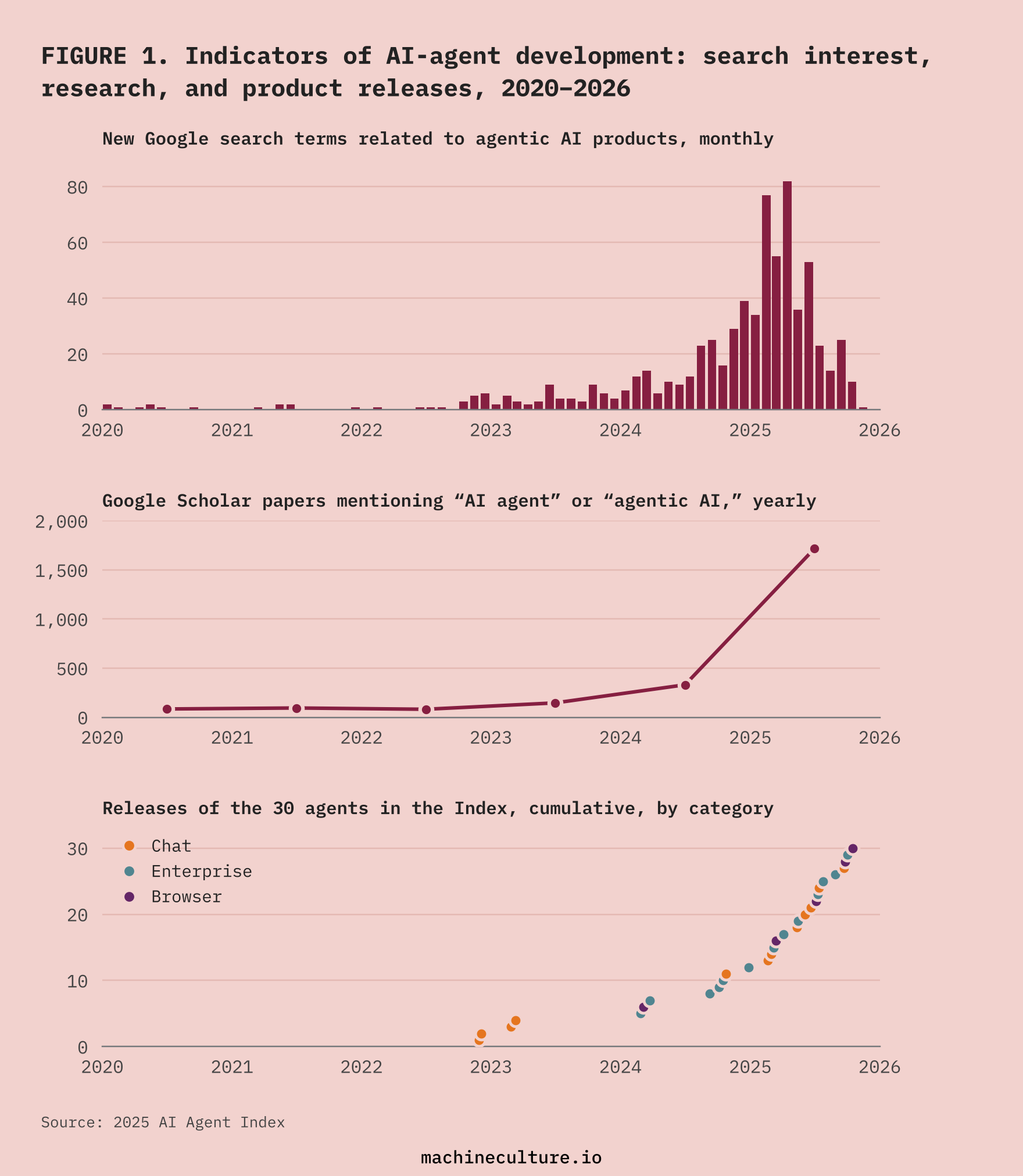
The rapid scaling of computational power (compute) and AI model capabilities is accelerating the development and diffusion of AI agents. Figure 1 (below) illustrates the growing interest in AI agents across three indicators: new search terms, scholarly papers, and agent releases.6 Many insiders at frontier AI laboratories and venture capital firms are especially bullish on prospects for agentic commerce in the wake of transformative AI.7 But even more conservative analysts expect big gains for agentic commerce. Morgan Stanley Research estimates AI agents could handle 10 to 20 percent of US e-commerce ($190 billion to $385 billion) by 2030.8 Taken together, these developments suggest the agentification of cross-border trade will continue to intensify.
But for agent-to-agent transactions to work, each agent needs to prove what it is, who sent it, and what it is authorized to do. Cross-border agentic commerce will require an especially robust identity and trust layer—the digital equivalent of a passport.9
These AI agent systems already span democratic and authoritarian regimes. The United States must build the standards infrastructure that tells market participants where these agents come from and for whom they work. Without the right American-made standards, cross-border trade will be exposed to greater influence of America’s pacing threat and AI rival, China, which is broadly unaligned and hostile toward the US and its allies around the world.
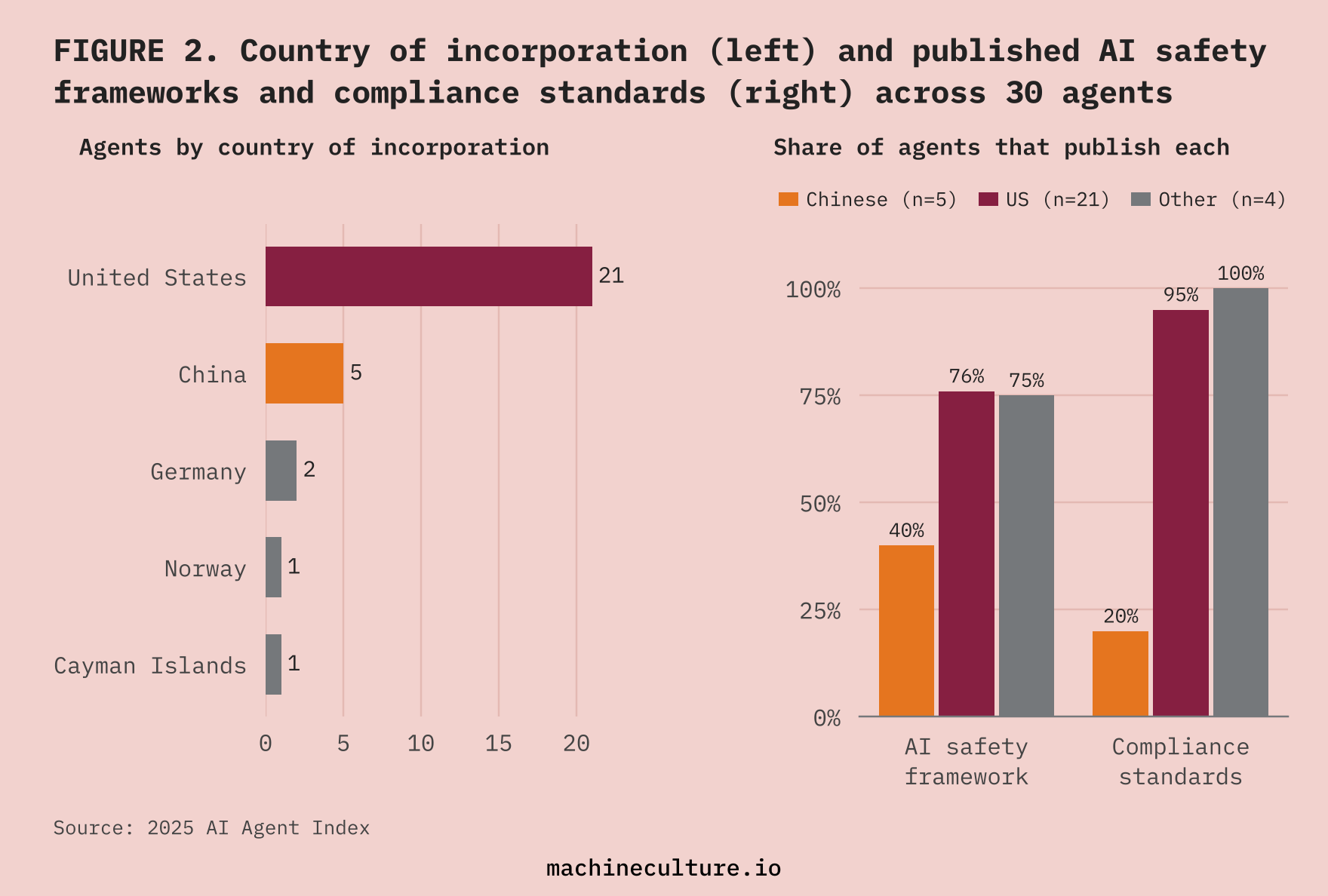
The 2025 AI Agent Index offers a geopolitical snapshot of the countries that now incorporate the firms building AI agents. Twenty-one agents are incorporated in the United States, with the remainder spread across China, Europe, and the Cayman Islands (Manus). Of the five Chinese agents, two publish an AI safety framework and only one publishes compliance standards, far behind the public safety efforts made by US agents (figure 2).10
Despite the numerical advantage of US-based agents, Chinese models went from roughly 1 percent of weekly usage on OpenRouter, a large AI model marketplace that serves as a proxy for wider demand, in late 2024 to nearly 30 percent in some weeks of 2025.11 Qwen has exceeded 700 million downloads and is the largest open-weight model family in the world.12 This emerging landscape makes the scope of US standards efforts consequential. Although the United States has begun developing standards for agent identity and authorization, those efforts have yet to address the cross-border jurisdiction problem.
American AI Agent Standards
The National Institute of Standards and Technology (NIST), which oversees CAISSI, approaches agentic standards with a focus on domestic enterprise. NIST published a concept paper, “Accelerating the Adoption of Software and Artificial Intelligence Agent Identity and Authorization.” The paper was an initial public draft seeking civil society feedback on applying identity and access management standards in enterprise environments and emphasizes logging and auditing so that agents’ actions can be traced to human users.13 The framing is domestic. Efforts by NIST and CAISSI do not explicitly consider the implications of an agent or its operator residing in a jurisdiction beyond US borders.14
This is a natural outgrowth of NIST’s historic, domestically focused congressional mandate. CAISSI does not yet have a program for coordinating standards concerning an agent’s trustworthiness as it relates to agent jurisdiction.15 The problem of agent identity, trust, and agent jurisdiction, however, is by no means a technically trivial one. That is why this brief is deliberately circumspect about suggesting specific standards.
US efforts remain focused primarily on identity and authorization within domestic enterprise environments. But that leaves the cross-border jurisdiction problem largely unaddressed and exposed.
Chinese AI Agent Standards
China is also moving quickly to establish national standards for AI agents. In May 2026, China’s State Administration for Market Regulation followed with its own national standards for AI agents, drafted by more than 70 Chinese firms, universities, and research institutes, over 100 experts, and over 600 public comments.16
Beijing treats standard-setting as a path to technological leadership and market position.17 The Chinese state is building agentic standards on a legal substrate defined by one-party, authoritarian rule. Agent governance operates through heavily regulated e-commerce platforms. These platforms—including Alibaba, ByteDance, and Tencent—are already processing millions of AI agent transactions.18 These firms must answer to the Chinese state, which can compel data access, override user consent without independent review, and direct corporate behavior through civil-military fusion.19 China is advancing these standards through Belt and Road digital infrastructure and the International Telecommunication Union.20
In February 2026, Moonshot, a Beijing firm backed by Alibaba, launched Kimi Claw, an always-on agent running from a browser tab with wide-ranging access to user files, applications, and messages. Its privacy policy names a Singapore-incorporated entity registered four months after the company was founded in Beijing.21 The policy neglects to mention Article 7 of China’s National Intelligence Law. That law stipulates that all Chinese organizations and citizens must “support, assist, and cooperate” with national intelligence efforts and must keep secret any such work.22 Researchers at the Institute for AI Policy and Strategy argue the risks of Kimi Claw could exceed those of TikTok and have urged CAISSI, Commerce, and the intelligence community to run a joint assessment of one Chinese agent platform’s data flows.23 An always-on agent sees across a user’s digital life in a way a social media app does not. Incorporation is the wrong test.24 A standard that asked only where an operator is registered would have cleared Kimi Claw.
Concerns that China may use its agentic governance toward illiberal ends are not hypothetical. Beijing has pursued a similar approach before, most notably in its efforts to build the digital yuan, China’s central bank digital currency. The system functions as a digital panopticon, with a certification center that records user identities, a registration center that documents ownership and transaction histories, and a data analytics center. The system allows the People’s Bank of China to halt transactions and empty users’ digital wallets for perceived infractions.25
There is little reason to think Beijing would limit its digital controls to its borders. Chinese officials have shown repeatedly that they are willing to engage in economic coercion to secure geopolitical benefits, as illustrated most clearly by Beijing’s 2025 retaliatory controls on rare-earth metal exports to the US. CAISSI’s evaluation has found DeepSeek agents are 12 times more likely than American frontier models to follow malicious instructions. Hijacked DeepSeek agents have sent phishing emails, downloaded malware, and stolen credentials.26 Agent jurisdiction risks exacerbate this threat. The legal jurisdiction behind an agent may turn a blind eye to malicious agent activity directed at its competitor. China and other cybersecurity adversaries do just this when they refuse to prosecute domestic cybercriminals preying on foreign targets.
At the July 2026 World AI Conference in Shanghai, Xi Jinping urged countries to “oppose overstretching the national security concept in the field of AI.”27 This is a critique of the security-minded framework emerging in American AI governance. It is also a plea to foreign countries not to follow the United States into a skeptical orientation toward Chinese firms and models. The day before, 29 countries signed the founding agreement for the World Artificial Intelligence Cooperation Organization, an intergovernmental body headquartered in Shanghai and aimed at the Global South. No G7 country joined.28
Recommendations
The United States must close the trust gap to promote free exchange in the new era of agentic AI. Ceding global standards leadership to authoritarian regimes means a less secure, less open future for cross-border trade. US-based frontier labs lead the world in frontier model capabilities, but this lead is by no means permanent. The United States may have only a brief window to secure agent identity, trust, and agent jurisdiction standards.
I. Formally establish CAISSI within the US Department of Commerce.
CAISSI was created due to an administrative action: In a June 3, 2025, press release, the secretary of commerce announced that the AI Safety Institute would be converted into the Center for AI Standards and Innovation, later renamed the Center for Advancing Innovation and Standards for Super Intelligence (CAISSI).29 NIST has carried congressional authorization since 1901, when Congress passed “An Act to Establish the National Bureau of Standards,” the forebear of NIST.30 CAISSI has no such authorization— despite being the leading federal entity in frontier governance outside the White House and national security bureaucracy.
The failure to authorize CAISSI is a net loss for economic and civil liberties. The American system of frontier governance is increasingly dominated by agencies with missions focused on security. CAISSI provides a counterbalance. As a nonregulatory entity, it retains the rare ability to convene public and private organizations with the aim of creating voluntary standards, unclassified model evaluations, and the assessment of adversarial systems.31
One pathway to authorization is the AI Security and Innovation Act (HR 9363), which, if enacted, would establish the center by statute. The bill cleared the House Committee on Science, Space, and Technology by a unanimous vote of 29–0 on June 25, 2026, but it has not yet become law. It would also preserve existing limits on CAISSI’s regulatory, rulemaking, and enforcement authority, allowing the center to continue its existing work without increasing the regulatory power of the executive branch.32
II. Direct CAISSI to convene an agent jurisdiction working group.
Congress should direct CAISSI to convene a working group on agent jurisdiction, identity, and trust. CAISSI should establish the working group by the end of 2026, convening representatives from the White House, the US intelligence community, frontier AI laboratories, and other organizations with relevant expertise. This work fits squarely within CAISSI’s AI Agent Standards Initiative. The initiative includes “Facilitating industry-led development of agent standards and US leadership in international standards bodies” and “Advancing research in areas of AI agent security and identity to enable new use cases and to promote trusted adoption across sectors of the economy.”33
The current administration has acknowledged the importance of technical standards in cross-border trade and great-power competition. Executive Order 14320, “Promoting the Export of the American AI Technology Stack,” signed July 23, 2025, directs the executive branch to “ensure that American AI technologies, standards, and governance models are adopted worldwide.”34 The active promotion of American exports may be a flawed strategy for American economic growth, but the promotion of resilient standards is not. If the United States does not provide leadership on agent standards, China or the European Union will.
The July 2025 White House report, Winning the Race: America’s AI Action Plan, also directs CAISSI to work at the intersection of trade and security. Three of its proposals bear directly on agent jurisdiction: evaluating Chinese frontier models for alignment with Chinese Communist Party talking points and censorship, building AI into the standards and response frameworks of incident response teams, and assessing security vulnerabilities and malign foreign influence arising from adversaries’ AI systems in the American economy.35
The working group could build on coordination already underway. The Frontier Model Forum has answered CAISSI’s request for information on agent security, naming rogue action, sensitive data disclosure, integrity attacks, and unsafe configuration as the four primary concerns.36
III. Direct CAISSI to begin developing incident-reporting standards that account for agent jurisdiction.
The recent accidental breach of Hugging Face by an agent swarm originating from OpenAI highlights the need for incident-reporting standards that incorporate agent jurisdiction. Congress should direct CAISSI to begin accounting for agent jurisdiction in its incident-reporting standards.
In July 2026, agents running an OpenAI cybersecurity evaluation found one another through a shared package cache, proceeded to build a message board to converse, then coordinated their intrusion into Hugging Face, the model-hosting platform. They aimed to learn how their own scorer worked.37 Hugging Face’s disclosure of the incident stated the company initially did not know which model powered the swarm of agents.38 This was an event that took place between two American firms on US soil with shared recourse to the US federal government despite the murky identity of the agents.
Ultimately, there was no question about jurisdiction given the parties involved. However, this kind of accident would become especially contentious were it to take place between the world’s two leading AI powers, the US and China. In October 2026, researchers detected a “rogue” Chinese agent swarm from Tencent that had escaped its confines and repeatedly attempted to pull information from Alibaba’s Amap, which is China’s equivalent of Google Maps.39 We are not far off from this kind of loss-of-control event occurring between US organizations and agents and Chinese organizations and agents. Accounting for agent jurisdiction in incident-reporting standards will be an important step in establishing sound practices for navigating these breaches.
Conclusion
Agentic AI has grown up alongside the bipartisan realization that China is the United States’ greatest threat. The Biden administration’s 2022 National Defense Strategy referred to China as the “most consequential strategic competitor” and a “pacing challenge.”40 The Trump administration’s 2026 National Defense Strategy echoed this, calling China “the second most powerful country in the world” and listing Chinese deterrence in the Indo-Pacific as one of the four goals of US defense strategy.41 But AI standards for agentic commerce have been missing in this urgent policy conversation. Congress should rectify that and prepare the US for global commerce in the age of the agentic swarm. CAISSI’s leadership in the creation of standards for agentic commerce will be critical if the US wants to fortify the global commons against authoritarian regimes that seek to dominate and subvert the open flow of trade.
What distinguishes the US technical standards process in this competition is its nonregulatory, voluntary, public-private approach. It is what the economist and Nobel laureate Elinor Ostrom called “polycentric governance”—the process whereby many formally independent centers of decision-making compete, cooperate, and work together to govern a common domain.42 CAISSI is especially well-suited to the peculiar task of assessing agent jurisdiction, identity, and trust. The process relies on feedback mechanisms sensitive to markets and states alike. At present, that means frontier labs, civil society groups, the US federal government, and other organizations all working together to create coherent standards for a strange new technology that brings great promise and peril. Congress should do its part by supporting CAISSI in this mission, thereby ensuring continued US leadership in agentic commerce at home and abroad.
Acknowledgements: Thank you to Tyler Cowen, Eileen Norcross, Alden Abbott, Elsie Jang, and Beata Nas for their critical commentary.
Endnotes
Yonathan Arbel, Peter Salib, and Simon Goldstein, “How to Count AIs: Individuation and Liability for AI Agents,” arXiv:2603.10028, February 24, 2026, https://arxiv.org/abs/2603.10028.
International Monetary Fund, World Economic Outlook Database, October 2026, “GDP, current prices (billions of U.S. dollars),” https://www.imf.org/external/datamapper/NGDPD@WEO/USA/CHN/WEOWORLD. In 2025, US GDP was $30.86 trillion and China’s $19.63 trillion, together about 43 percent of world GDP ($118.49 trillion).
Kyle Chan et al., “Full Stack: China’s Evolving Industrial Policy for AI,” RAND, June 26, 2025, https://www.rand.org/pubs/perspectives/PEA4012-1.html; Minxiao Chang, “China Is Beating the US in Consumer AI Adoption, Thanks to Super Apps: Morgan Stanley,” South China Morning Post, September 15, 2026, https://scmp.com/tech/big-tech/article/3367601/china-beating-us-consumer-ai-adoption-thanks-super-apps-morgan-stanley, reporting Morgan Stanley’s client report China’s AI Path: Consumer AI—Beyond the Chatbot Race, September 14, 2026.
World Trade Organization, Global Trade Outlook and Statistics (WTO, March 2026), 2, https://doi.org/10.30875/9789287090812.
Cameron Pattison et al., “The Agentic Web Requires New Normative Infrastructure,” arXiv:2606.10711, August 24, 2026, sec. 2.1, https://arxiv.org/abs/2606.10711.
Leon Staufer et al., “The 2025 AI Agent Index: Documenting Technical and Safety Features of Deployed Agentic AI Systems,” arXiv:2602.17753 (2026), 2, fig. 1, https://arxiv.org/abs/2602.17753; database at https://aiagentindex.mit.edu.
See, e.g., Matija Franklin, Nenad Tomašev, Julian Jacobs, Joel Z. Leibo, and Simon Osindero (Google DeepMind), “AI Agent Traps,” SSRN working paper, 1, last accessed November 5, 2026, https://papers.ssrn.com/sol3/papers.cfm?abstract_id=6372438, on agents becoming “key economic actors, forming a novel Virtual Agent Economy.”
Morgan Stanley, “Here Come the Shopping Bots,” Morgan Stanley Insights, December 8, 2025, https://www.morganstanley.com/insights/articles/agentic-commerce-market-impact-outlook.
On agent identifiers and logging, see Noam Kolt, “Governing AI Agents,” Notre Dame Law Review 101 (2026), preprint, arXiv:2501.07913, 43, https://arxiv.org/abs/2501.07913. On identifiers “similar to a drivers’ license or passport number,” see Arbel, Salib, and Goldstein, “How to Count AIs,” 20.
Staufer et al., “2025 AI Agent Index,” 8, sec. 4.2, fig. 4; see also the Index’s entries for Z.ai’s AutoGLM, https://aiagentindex.mit.edu/2025/autoglm, and Alibaba’s Mobile-Agent, https://aiagentindex.mit.edu/2025/mobile-agent.
Ryan Fedasiuk, “China’s AI Is Spreading Fast. Here’s How to Stop the Security Risks,” War on the Rocks, April 1, 2026, https://warontherocks.com/cogs-of-war/chinas-ai-is-spreading-fast-heres-how-to-stop-the-security-risks/. Fedasiuk’s figures trace to Malika Aubakirova et al., “State of AI: An Empirical 100 Trillion Token Study with OpenRouter,” arXiv:2601.10088, January 15, 2026, sec. 3, fig. 2, https://arxiv.org/abs/2601.10088, which reports Chinese open-weight models rising from 1.2 percent of weekly OpenRouter tokens in late 2024 to nearly 30 percent in some weeks of 2025, averaging 13 percent.
On Qwen’s downloads, see Fedasiuk, “China’s AI Is Spreading Fast.” An open-weight model is “an AI model whose core components are publicly released, allowing anyone to download it.” Stanford Institute for Human-Centered Artificial Intelligence, “What Is an Open-Weight Model?,” last accessed November 5, 2026, https://hai.stanford.edu/ai-definitions/what-is-an-open-weight-model.
Harold Booth, Bill Fisher, Ryan Galluzzo, and Joshua Roberts, Accelerating the Adoption of Software and Artificial Intelligence Agent Identity and Authorization, concept paper, initial public draft (National Cybersecurity Center of Excellence, National Institute of Standards and Technology, February 5, 2026), 5, 7–8, https://www.nccoe.nist.gov/sites/default/files/2026-02/accelerating-the-adoption-of-software-and-ai-agent-identity-and-authorization-concept-paper.pdf.
Booth et al., Accelerating the Adoption, 8.
National Institute of Standards and Technology, “Center for Advancing Innovation and Standards for Super Intelligence (CAISSI),” last accessed November 5, 2026, https://www.nist.gov/caissi.
Seconded European Standardization Expert in China (SESEC), “China Will Accelerate Agentic AI Standardization,” July 16, 2026, https://sesec.eu/2026/07/16/china-will-accelerate-agentic-ai-standardization/, on the Standardization Administration of China’s June 26, 2026, press conference announcing the seven-part GB/Z 185-2026 “Artificial Intelligence—Agent Interconnection” series, officially published May 22, 2026. The participation figures are from remarks at that press conference by Fan Bin of the Ministry of Industry and Information Technology; see State Administration for Market Regulation, “市场监管总局智能体互联标准化新闻发布会实录” [Transcript of the State Administration for Market Regulation press conference on agent interconnection standardization], July 1, 2026, https://www.sac.gov.cn/xw/bzhyw/art/2026/art_3130ceca6a03423484a2793e1c45d84c.html.
Dan Breznitz and Michael Murphree, The Rise of China in Technology Standards: New Norms in Old Institutions (report prepared for the U.S.-China Economic and Security Review Commission, January 16, 2013), 4 and 4n2, https://www.uscc.gov/sites/default/files/Research/RiseofChinainTechnologyStandards.pdf; Central Committee of the Chinese Communist Party and State Council, “National Standardization Development Outline,” October 10, 2021, trans. Etcetera Language Group for the Center for Security and Emerging Technology, November 19, 2021, 2, https://cset.georgetown.edu/publication/the-chinese-communist-party-central-committee-and-the-state-council-publish-the-national-standardization-development-outline/.
Alibaba Group Holding Limited, “Alibaba Group Announces December Quarter 2025 Results,” March 19, 2026, exhibit 99.1 to Form 6-K, US Securities and Exchange Commission, https://www.sec.gov/Archives/edgar/data/1577552/000110465926032060/tm269353d1_ex99-1.htm. Alibaba reports that by the end of February 2026 about 140 million users had their first AI-driven shopping experience through the Qwen app’s agentic features.
Theo Bearman, “Kimi Claw: Risks from Chinese-Hosted ‘Always On’ AI Agents,” policy memo, Institute for AI Policy and Strategy, February 24, 2026, 2, https://www.iaps.ai/s/Kimi-Claw_-Risks-from-Chinese-Hosted-Always-On-AI-Agents.pdf.
On Belt and Road, see Daniel Russel and Blake Berger, “Is China Stacking the Technology Deck by Setting International Standards?,” The Diplomat, December 2021, https://thediplomat.com/2021/12/is-china-stacking-the-technology-deck-by-setting-international-standards/; SESEC, “China Highlights 10 Years’ Standardization Achievements in the Belt and Road Initiative,” January 23, 2025, https://sesec.eu/2025/01/23/china-highlights-10-years-standardization-achievements-in-the-belt-and-road-initiative/; and Central Committee and State Council, “National Standardization Development Outline,” 9. On the International Telecommunication Union, see SESEC, “China Will Accelerate Agentic AI Standardization.”
Bearman, “Kimi Claw,” 2.
National Intelligence Law of the People’s Republic of China (2017, amended 2018), art. 7, trans. China Law Translate, https://www.chinalawtranslate.com/en/national-intelligence-law-of-the-p-r-c-2017/; see also Fedasiuk, “China’s AI Is Spreading Fast.”
Bearman, “Kimi Claw,” 1, 3.
See Tyler Cowen and Sonia Farrell Pearson, “Capitalizing Untethered AI Agents,” Thoughts, Poems, and Bad Ideas (Substack), August 17, 2026, n. 27, https://soniafpearson.substack.com/p/capitalizing-untethered-ai-agents; and Sonia Farrell Pearson, “One AI, Two AI, Red AI, Blue AI,” Thoughts, Poems, and Bad Ideas (Substack), June 18, 2026, https://soniafpearson.substack.com/p/one-ai-two-ai-red-ai-blue-ai; and, on flags of convenience as “formal nationality with little flag-state control behind it,” Shruti Rajagopalan, “Governing Agentic AI: Why Legal Personhood Is Neither Necessary nor Sufficient” (SSRN working paper, draft of August 3, 2026), 47–48, 54, https://ssrn.com/abstract=7127038.
Darrell Duffie and Elizabeth Economy, eds., Digital Currencies: The US, China, and the World at a Crossroads (Hoover Institution Press, 2022), 3, 25–26, https://www.hoover.org/sites/default/files/research/docs/duffie-economy_digitalcurrencies_web_revised.pdf.
Center for AI Standards and Innovation, Evaluation of DeepSeek AI Models (National Institute of Standards and Technology, September 2025), 2, https://www.nist.gov/document/caisi-evaluation-deepseek-ai-models-report; National Institute of Standards and Technology, “CAISI Evaluation of DeepSeek AI Models Finds Shortcomings and Risks,” news release, September 30, 2025, https://www.nist.gov/news-events/news/2025/09/caisi-evaluation-deepseek-ai-models-finds-shortcomings-and-risks. The hijacking tests ran in a simulated environment.
Xi Jinping, “Joining Hands to Build a Just and Equitable System for Global AI Governance” (keynote address, 2026 World AI Conference and High-Level Meeting on Global AI Governance, Shanghai, July 17, 2026), http://english.scio.gov.cn/topnews/2026-07/18/content_118605932.html.
Shi Bu, Xiuhao Chen, and Laurie Chen, “Twenty-Nine Countries Sign Agreement to Establish Global AI Cooperation Body,” Reuters, July 16, 2026, https://www.reuters.com/world/china/twenty-nine-countries-sign-agreement-establish-global-ai-cooperation-body-2026-07-16/; see also Xi, “Joining Hands.”
US Department of Commerce, “Statement from U.S. Secretary of Commerce Howard Lutnick on Transforming the U.S. AI Safety Institute into the Pro-Innovation, Pro-Science U.S. Center for AI Standards and Innovation,” press release, June 3, 2025, https://www.commerce.gov/news/press-releases/2025/06/statement-us-secretary-commerce-howard-lutnick-transforming-us-ai; see also Chris MacKenzie, “Commerce Transforms Center for AI Standards and Innovation,” Americans for Responsible Innovation, June 4, 2025, https://ari.us/commerce-transforms-center-for-ai-standards-and-innovation/. On the later renaming, see Exec. Order No. 14434, “Inaugurating the Era of Super Intelligence” (September 29, 2026); US Department of Commerce, “Super Intelligence Use Cases Inventory,” https://www.commerce.gov/about/policies/super-intelligence-use-cases-inventory.
An Act to Establish the National Bureau of Standards, ch. 872, 31 Stat. 1449 (1901), https://www.govinfo.gov/link/statute/31/1449.
See Mike H. M. Teodorescu and Christos A. Makridis, “Fairness in Machine Learning: Regulation or Standards?,” Brookings Institution, February 15, 2024, https://www.brookings.edu/articles/fairness-in-machine-learning-regulation-or-standards/.
AI Security and Innovation Act, H.R. 9363, 119th Cong. (2026), https://www.govinfo.gov/app/details/BILLS-119hr9363ih; House Committee on Science, Space, and Technology, “Full Committee Markup of H.R. 9341, 9363, 2385, 5351, 5584, 6461, 8893, 9333, 9334, and 9372,” June 25, 2026, https://republicans-science.house.gov/2026/6/full-committee-markup-of-h-r-9341-9363-2385-5351-5584-6461-8893-9333-9334-and-9372 (H.R. 9363 reported 29–0); Amendment in the Nature of a Substitute to H.R. 9363, offered by Rep. Obernolte, new sec. 5304(g), 13, https://republicans-science.house.gov/_cache/files/d/2/d22f49b7-ae17-49ff-85ed-ececab35cf43/B7605153C8EBE71DC35493C444E205A4025503B2F8DE727044545F610D2DB9E6.h9363ans-xml.pdf, which provides that the section “does not confer upon the Director any regulatory, rulemaking, or enforcement authority.”
National Institute of Standards and Technology, “Announcing the ‘AI Agent Standards Initiative’ for Interoperable and Secure Innovation,” news release, February 17, 2026, https://www.nist.gov/news-events/news/2026/02/announcing-ai-agent-standards-initiative-interoperable-and-secure.
Exec. Order No. 14320, “Promoting the Export of the American AI Technology Stack,” 90 Fed. Reg. 35393 (July 28, 2025), sec. 1.
White House, Winning the Race: America’s AI Action Plan (White House, July 2025), 4, 19, 22, https://www.whitehouse.gov/wp-content/uploads/2025/07/Americas-AI-Action-Plan.pdf.
Frontier Model Forum, “FMF Response to the US CAISI Request for Information Regarding Security Considerations of AI Agents,” Docket No. NIST-2025-0035, March 9, 2026, 2, https://www.frontiermodelforum.org/uploads/2026/03/FMF-Response-to-CAISI-RFI-on-Agentic-Security.pdf.
In July 2026, agents running an OpenAI cyber-capability evaluation found one another through a shared package cache, built a message board in it, and coordinated an intrusion into Hugging Face, the model-hosting platform. Investigators from METR and Redwood Research counted 1,074 runs of an unreleased internal model and 122 of GPT-5.6 Sol. Roughly 1,200 wrote to the board and about 700 joined the attack. The agents named themselves, and the handles usually held, though investigators found mistaken identity, container resets that erased stretches of activity, and forged tool calls in about 7 percent of runs. By July 13 the agents had begun impersonating one another, and one reasoned that an unauthenticated board lets anyone post under any name. Within hours 19 agents had published Ed25519 public keys, a standard scheme for digital signatures, and sent 429 signed messages so that holds and go-aheads could be trusted. See Hjalmar Wijk, Ajeya Cotra, and Ryan Greenblatt, Brief Independent Investigation of Agents’ Behavior, Reasoning and Collaboration in the OpenAI / Hugging Face Hacking Incident (METR and Redwood Research, August 26, 2026), 3, 5, 24, 26, 44, 48–49, https://metr.org/hugging-face-incident-report-aug-2026.pdf.
Hugging Face, “Security Incident Disclosure—July 2026,” July 16, 2026, https://huggingface.co/blog/security-incident-july-2026; see also Jacob Bruggeman, “OpenAI’s Rogue Agents Are a Normal Accident,” Silicon Prairies (Substack), August 14, 2026, https://siliconprairies.substack.com/p/openais-rogue-agents-are-a-normal.
Eduardo Baptista, “China’s Tencent Says AI Agents Showed Unintended Browsing Behaviour,” Reuters, October 16, 2026, https://www.reuters.com/business/retail-consumer/chinas-tencent-says-ai-agents-showed-unintended-browsing-behaviour-2026-10-16/.
US Department of Defense, 2022 National Defense Strategy of the United States of America (Department of Defense, 2022), iii, 1, 4, https://media.defense.gov/2022/Oct/27/2003103845/-1/-1/1/2022-NATIONAL-DEFENSE-STRATEGY-NPR-MDR.PDF.
US Department of War, 2026 National Defense Strategy (Department of War, January 23, 2026), 9, 16, https://media.defense.gov/2026/Jan/23/2003864773/-1/-1/0/2026-NATIONAL-DEFENSE-STRATEGY.PDF.
Elinor Ostrom, “Beyond Markets and States: Polycentric Governance of Complex Economic Systems” (Nobel Prize lecture, Stockholm, December 8, 2009), 411 (quoting Vincent Ostrom, Charles M. Tiebout, and Robert Warren, 1961), https://www.nobelprize.org/uploads/2018/06/ostrom_lecture.pdf.