
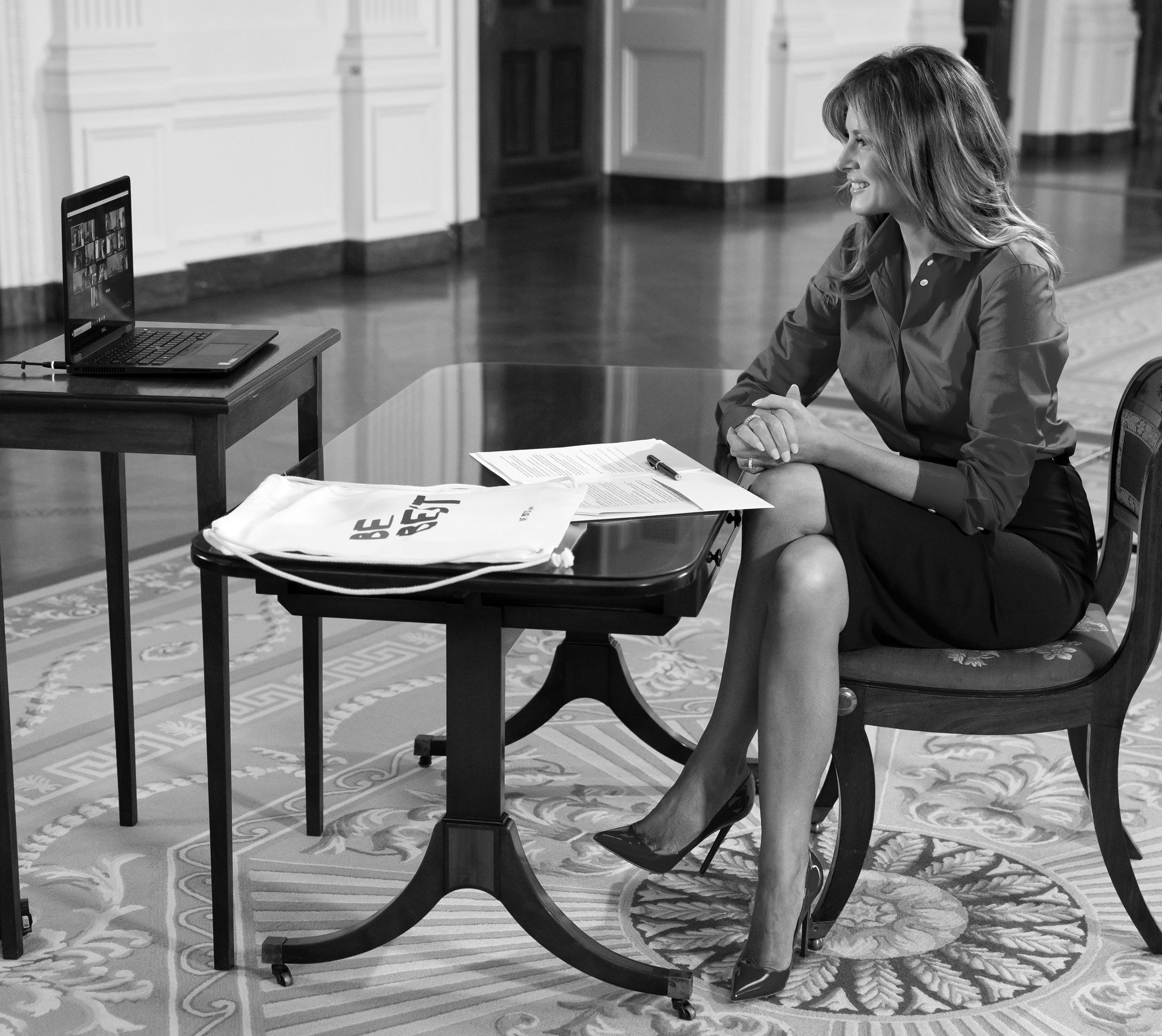
To understand frontier governance, one must understand the White House. And to do that, it helps to watch Melania. The documentary, released in January this year, is nothing short of a self-portrait of soft power. Its subject is one of America’s leading advocates for AI adoption outside the rarefied worlds of the Pentagon and Silicon Valley.
Melania speaks to the people. The film curates in minute detail the First Lady’s work administering the “dignified” parts of constitutional government. That is, as Walter Bagehot argues, those parts by which a government may “excite and preserve the reverence of the population.” Such parts stand in contrast to the “efficient” parts by which a government “works and rules.” One part shores up, the other deploys. They work in concert.
The film is a slow, serious meditation on the First Lady’s status and noblesse oblige. There are extended scenes of high-end, precision tailoring in preparation for the inauguration. There is mourning and veneration at St. Patrick’s Cathedral in New York City. We see the first couple discuss their security concerns about the parade route, still burdened by the peril they felt in Butler, Pennsylvania. And there are the SUVs —— black, heavy, undaunted caravans that move the entourage from tarmac to sanctuary and back again. Anyone can ride in a limo. Few can pull up to a jet’s boarding ramp. Fewer still can halt the traffic.
The full techno-industrialist court is present on film, at the inaugural dinners and on the dais, as the First Lady goes about her official tasks. Elon Musk, Jeff Bezos, Mark Zuckerberg, and other titans come and go, and Barron Trump ascends the stage to greet the roaring crowd inside a great arena. The camera lingers on his stern visage. The viewer is asked to consider his great height, like that of his parents. He will be 35 years of age in 2041, constitutionally eligible to sit behind the Resolute desk.
In the American republic, the dignified and the efficient parts of government are now deeply entangled in the executive branch. The Presidency, especially, has come to take on more and more of the dignified, ritualistic affairs of state while the First Lady has become, to a lesser degree, more efficient and practical. The Constitution mandates neither movement, but the convergence happens all the same. America has never been a constitutional monarchy, but it has often embraced a kind of “natural aristocracy,” as Thomas Jefferson called it. Many have derided the existence of this class, but most have desired to join it.
So when the First Lady turns her eyes to the cause of AI adoption —— particularly as it relates to children, safety, and education —— she does so with the full authority of the American constitutional order, if not always its full power. She dignifies the technology, asking citizens only to use it well and for the benefit of the republic. Her role may have little to no effect on the arcane details of frontier AI governance —— model evaluations, critical infrastructure, rogue swarms, power centralization, and algorithmic warfare. But her work reaches far more people than any long essay by Dario Amodei or punchy tweet by Roon might.
If technological diffusion is the means by which great powers rise and fall, the role of the First Lady cannot be ignored for her work in the symbolic promotion of the new technology. Consider her accomplishments in AI advocacy in just the first two years since her second ascension to office.
The First Lady was the White House’s primary advocate for the TAKE IT DOWN Act, the only congressional legislation on AI yet enacted in the second Trump administration. That bill passed the Senate unanimously and the House 409 to 2. A federal criminal law imposing new regulatory requirements on tech firms is not the kind of bill one might expect to pass so easily. That is no doubt a result of the moral load it carried. But she was willing to carry that load and to be seen carrying it.
Melania Trump also runs the Presidential AI Challenge for grade school children, and she participates in the White House Task Force on AI Education. On the White House lawn, she hosted Queen Camilla and engaged children with Meta virtual reality glasses.
The First Lady also leads Fostering the Future Together, a coalition of first spouses and major tech firms working to diffuse AI tools to member countries at low or no cost. (The details, like the program title, are quite vague.) Meta, Google, OpenAI, Microsoft, and Palantir are all on board, partnering with the first spouses of 45 countries. South Korea was the first country to join, and that agreement was folded into the U.S.–Korea Technology Prosperity Deal.
She has even used an AI voice clone built by ElevenLabs to narrate her memoir in audiobook form. Even Vice President J.D. Vance —— a Thielverse champion of “little tech” —— did not do this for his most recent memoir, Communion, a book which strangely says very little about the promise and peril of artificial intelligence.
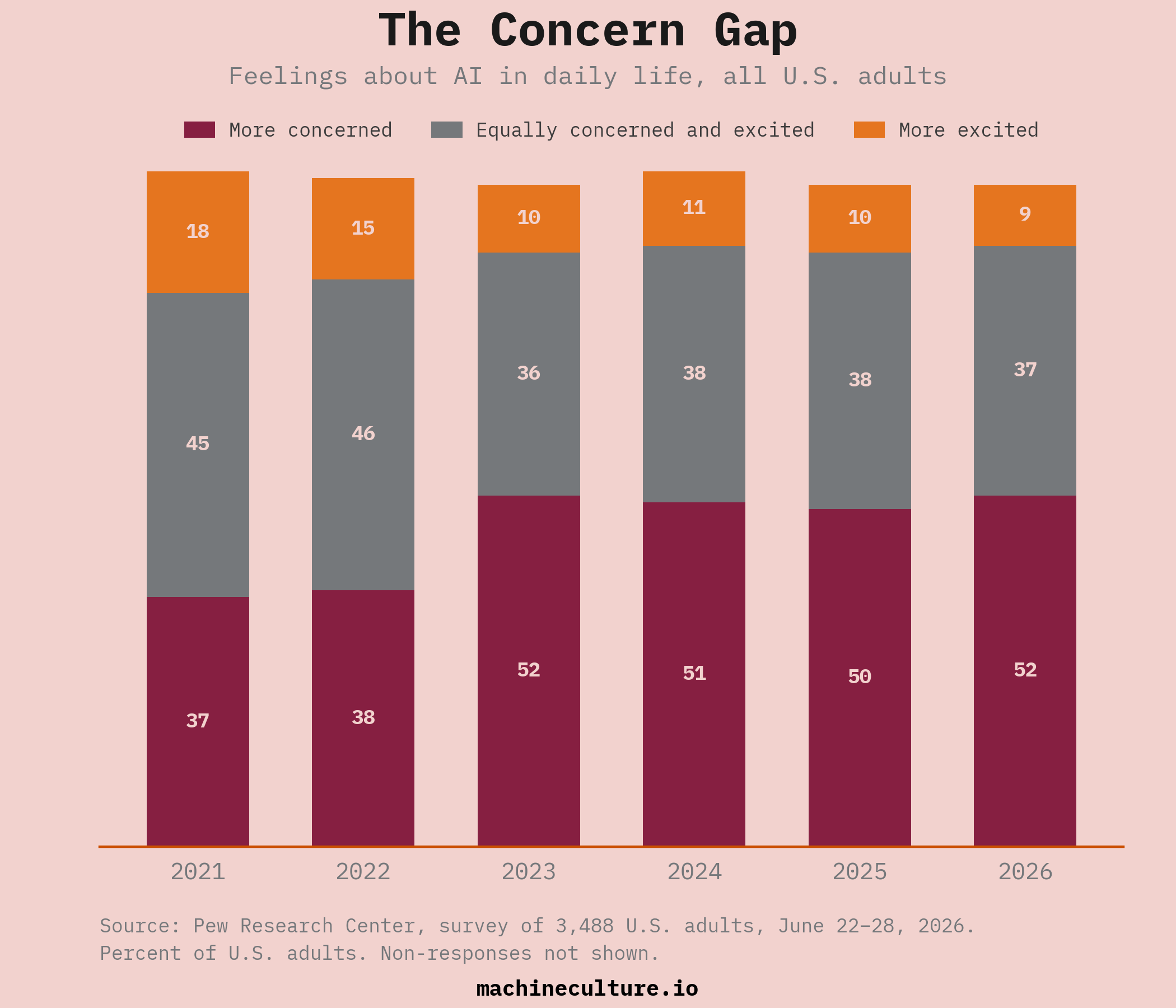
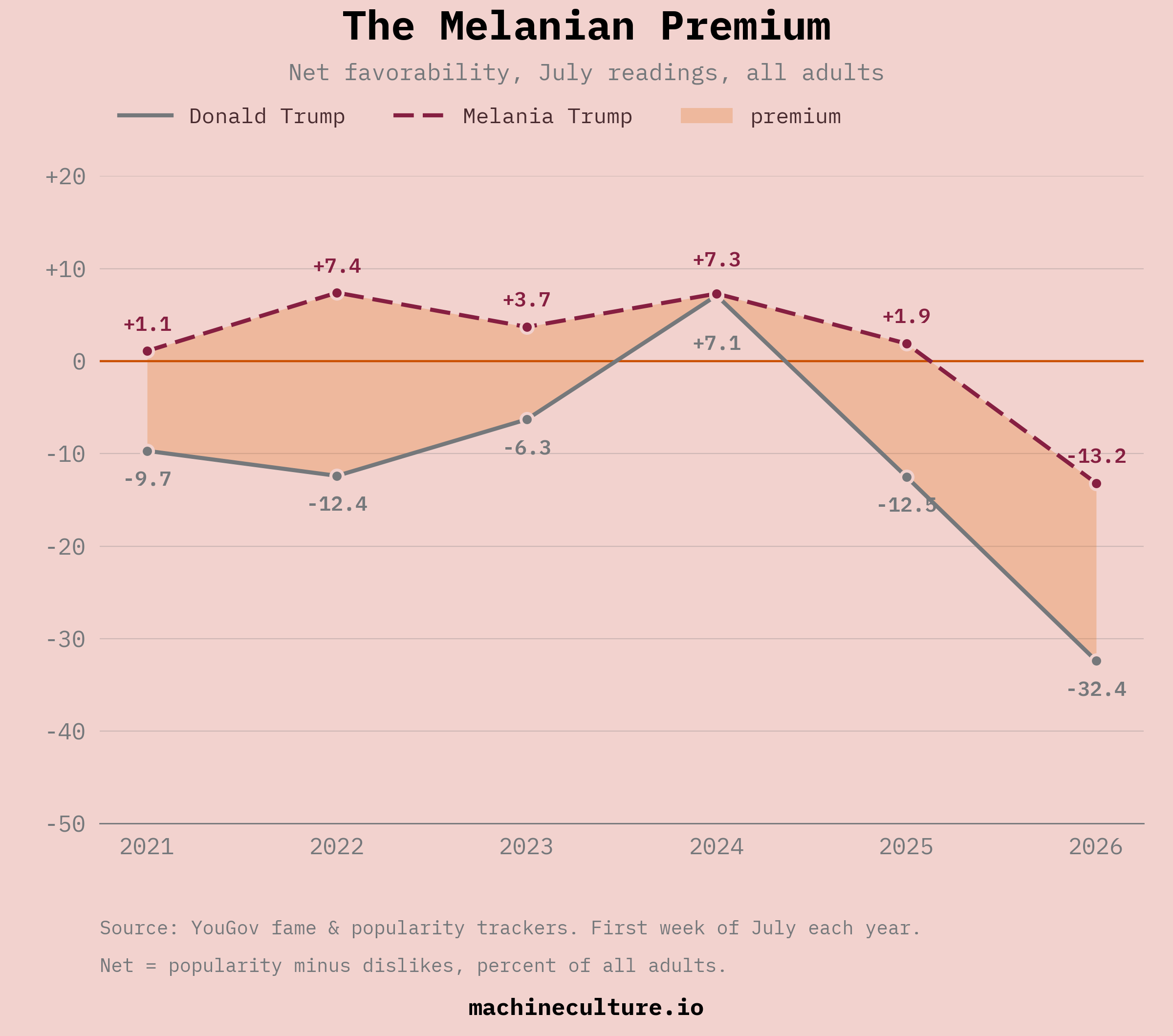
Besides the TAKE IT DOWN Act, none of these initiatives are likely to survive the next presidential transition of power. But the less-visible hand of the First Lady still nudges the culture in more lasting ways —— especially among Republican voters, many of whom are skeptical of the new technology. Even as the President’s favorability suffers from inflationary and wartime pressures, the First Lady’s reputation still enjoys a relative premium. This is historically the norm across First Ladies as well.
That quiet dignification has practical consequences for American culture and policymaking. Dolley Madison did as much when she rescued George Washington’s portrait from destruction at the hands of the British. Eleanor Roosevelt did so in her support of the New Deal. Edith Wilson also did so in extremis as she assumed a short-lived, unofficial co-presidency in the wake of her husband’s stroke. And it is what Melania Trump is doing now as she steps across the frozen front lines of AI diffusion.
If you do not like the film, it was not meant for you. It was meant for those who vote with their time, money, and ballots for the film’s protagonists. So, perhaps you missed it when it first came out. Perhaps you read Vanity Fair’s review, which said that “all the money in the world can’t make good propaganda” —— forgetting, for a moment, that Virgil’s epic poem, the Aeneid, pulled it off. Or perhaps you saw it garnered positive reviews among only 10 percent of its critics. And you declined to attend the ceremony.
But in so doing, you missed a chance to see what other Americans are seeing —— about the administration, AI, and the natural aristocracy that has extended across the houses of Adams, Harrison, Roosevelt, Kennedy, Bush, and Trump. And according to that aforementioned set of metrics, Melania now has a 99 percent positive reception among viewers —— an implausibly high if directionally suggestive number given the intense selection effect. Amazon, the sole distributor of the film, has it at four out of five stars. Those who watched it seem to like it.
It is the most expensive documentary ever —— a costly signal made clear in the movie’s conspicuous use of “Billie Jean,” “Gimme Shelter,” and “Everybody Wants to Rule the World” for its soundtrack. Despite its relative commercial success as a documentary —— and it had the best non-music documentary opening in 14 years —— the project was still a critical bust and a financial flop.
But that was never the point.