


Introduction
The nationalization of frontier AI labs is no longer just a thought experiment.
In September 2025, Senators Josh Hawley (R-MO) and Richard Blumenthal (D-CT) introduced the Artificial Intelligence Risk Evaluation Act (S.2938). In Section 5(b)(8), the bill directs the Department of Energy to “develop proposed options for regulatory or governmental oversight, including potential nationalization or other strategic measures, [emphases ours] for preventing or managing the development of artificial superintelligence.” Senator Marsha Blackburn (R-TN) later incorporated that language into her TRUMP AMERICA AI Act, a 291-page draft omnibus framework introduced in March 2026.
We have been closely following federal discussions around AI governance, so putting “nationalization” into bill text as a policy option seemed to us unprecedented in modern American legislation. We have discussed the normative dimensions of this proposal in a separate post, but for now we wanted to understand how the word has been used in recent Congressional history.
To that end, we built a pipeline that searched the full text of every bill and floor speech in the Congressional Record available through the GovInfo database going back to 1993 and used an LLM to classify each mention by how it was being used.
Bottom Line Up Front: “Nationalization” has been a congressional slur for 30 years; 78 percent of the 1,424 mentions we analyzed were rhetorical attacks. The Hawley-Blumenthal AI bill represents an Overton window shift as the first bipartisan legislation to put nationalization in bill text as a forward-looking contingency.
Results
Across 1,424 mentions of “nationalization,” “nationalize,” and “government takeover,” excluding the AI bill, here is what Congress means when it says those words:
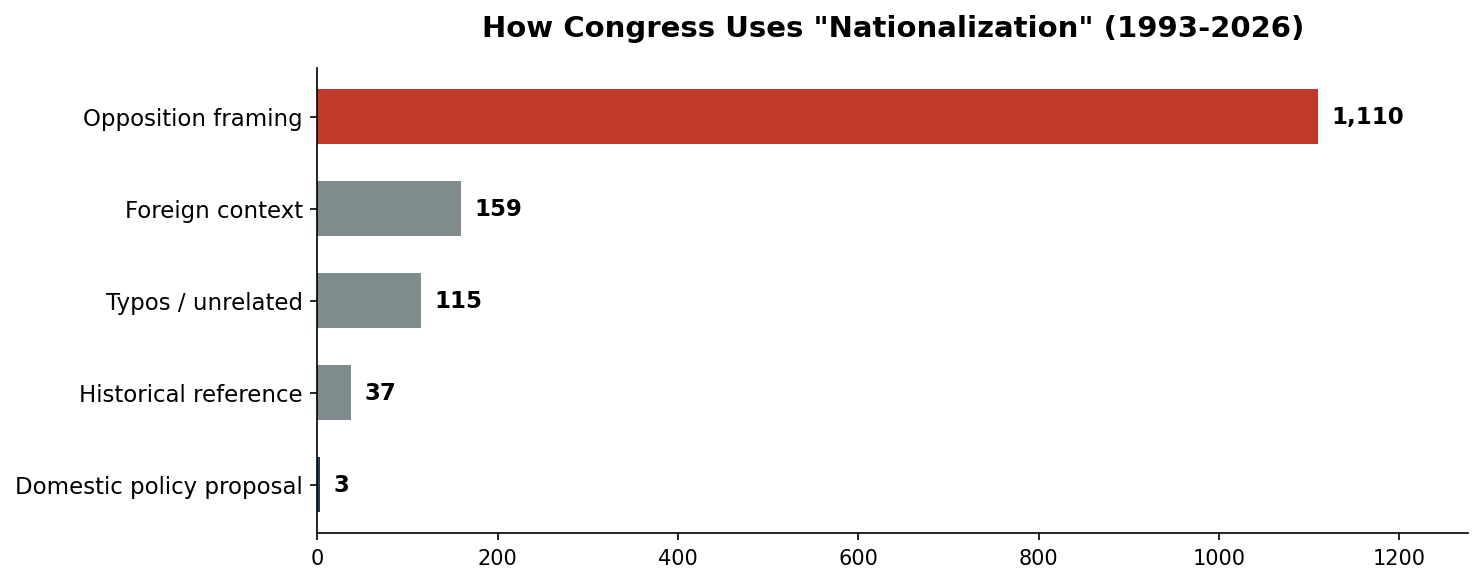
Opposition Framing (77.9%)
Opposition framing is by far the largest category, at 1,109 out of 1,424 classified results. When members of Congress use “nationalization” or “government takeover” in relation to domestic policy, it is overwhelmingly an accusation, e.g., the other side is trying to nationalize healthcare, banks, or education.
The Affordable Care Act debate of 2009-2010 dominates this category. “Government takeover of healthcare” was repeated on the House and Senate floor hundreds of times, sometimes as the literal title of floor speeches.
During the 2008-2009 financial crisis, members argued against nationalizing auto companies during the bailout debate and described the conservatorship of Fannie Mae and Freddie Mac as nationalization.
In 2019, Senator Ted Cruz (R-TX) introduced the E-FRONTIER Act to protect 5G networks from nationalization.
When Congress put “government takeover” into legislation, it was always as something to be stopped, never as something to be done.
Foreign Context (11.2%)
Foreign context is the second largest category at 159 mentions. When Congress discusses nationalization, it is overwhelmingly talking about other countries doing it. The Cuban Liberty and Democratic Solidarity Act (LIBERTAD) deals with Cuba’s nationalization of American-owned property. Similar bills address Venezuela under Chavez and Chinese business practices.
Typos and Unrelated Usage (8.1%)
In 114 results, the word “nationalization” has nothing to do with government control of industry. The most common culprit is a simple spelling error. The congressional record repeatedly refers to the “Immigration and Nationalization Service” when the actual agency was the Immigration and Naturalization Service. This mistake appears in the Violent Criminal Incarceration Act of 1995 and several budget resolutions and floor speeches.
The rest of this category uses “nationalizing” to mean “making something national in scope,” as in the Developing and Nationalizing Key Cannabis Research Act, 15 versions of the Indian Health Care Improvement Act (which uses “nationalization” to mean expanding a regional Community Health Aide Program in Alaska to the national level), or describing making a local election about national issues.
Historical Reference (2.6%)
In 36 results, members of Congress reference nationalization as something that happened in the past, both abroad and at home. These include Iran’s nationalization of British oil assets in 1951, Guatemala’s threat to nationalize United Fruit Company holdings in the 1950s, communist regimes in Eastern Europe seizing foreign insurance company assets after WWII, Mexico’s nationalization of its oil industry, England’s nationalization of healthcare in 1948, the near-nationalization of American railroads in the late 1970s, and President Truman’s attempt to nationalize steel mills during the Korean War.
The 3 Policy Proposals (0.2%)
Besides the AI bill, only 3 results out of 1,424 are instances where a member of Congress seriously entertained nationalizing a domestic industry. In chronological order:
In January 2009, Representative Dennis Kucinich (D-OH) proposed nationalizing the Federal Reserve by placing it under Treasury control, arguing this would let the government spend money directly into circulation rather than borrowing from banks.
In February 2009, Representative Jim McDermott (D-WA) acknowledged bank nationalization as a potential policy option that might be necessary, presented as one of several tough decisions the President might need to make.
In February 2021, Representative Sheila Jackson Lee (D-TX) proposed the COVID-19 Delivery Act, which included “nationalization or federalization of distribution” to organize vaccine delivery. This is the closest pre-AI parallel of nationalization in actual bill language.
Takeaways
The language of nationalization in the Hawley-Blumenthal AI Risk Evaluation Act is largely without precedent. The 2008-2009 financial crisis saw congressional discussion of bank nationalization, and Representative Jackson Lee’s 2021 vaccine distribution bill used similar language.
Yet it is distinctive in two ways:
First, it is in bill text, with bipartisan cosponsorship. The bank nationalization discussion stayed at the level of floor speeches, and nobody put “nationalize the banks” into a bill as a policy option. Senator Hawley did that for AI, with a Democratic cosponsor in Senator Blumenthal, and Republican Senator Blackburn incorporating the language months later into her own framework.
Second, it is prospective rather than reactive. The discussion after the financial crisis was about nationalizing institutions that had already failed. The AI bill is about developing plans to nationalize an industry that has not failed, in preparation for artificial superintelligence that does not yet exist.
The Artificial Intelligence Risk Evaluation Act thus represents an Overton window shift, moving nationalization from political attack to policy.
Methodology
This analysis was conducted on March 29, 2026, using publicly available data from the Library of Congress and the Government Publishing Office.
We searched the full text of congressional bills and the Congressional Record for “nationalization,” “nationalize,” “nationalizing,” and “government takeover,” pulling all matches through the GovInfo Search API. We then enriched each result with bill metadata from the Congress.gov API and ran them through Claude Sonnet 4, which classified each mention by how it was being used (opposition framing, foreign context, historical reference, and so on) and whether it represented a serious policy proposal.
After Claude’s classification, we manually reviewed the results and reclassified entries where the LLM had miscategorized the usage. For example, several results initially labeled as “policy proposals” turned out to be constituent mail read into the record, historical references to past nationalization efforts, or members deflecting questions about nationalization rather than endorsing it.
The GovInfo database we used for this project only covers bills after 1993 and the Congressional Record after 1994. Because of this selection bias, we were forced to exclude nationalization debates that took place before the Reagan realignment. That means we did not analyze congressional debates around the Progressive era, New Deal, Great Society, and 1970s energy crisis, when congressional nationalization proposals were likely deployed more favorably.
Our code and full dataset are available on GitHub.